Click the graphic above to access all our novel studies!!

Thursday, September 30

Red Hugh of Ireland & the English Civil Wars

The English Civil War (1642–1651) was a series of civil wars and political machinations between Parliamentarians ("Roundheads") and Royalists ("Cavaliers"), mainly over the manner of England's governance and issues of religious freedom...

After years of conflict between Parliament and King Charles I, the king tried to arrest five members of Parliament in 1642 who had been actively disagreeing with his policies. These members fled into the back streets of London, but when the king went after them, the citizens expelled him angrily from their city. This was a direct violation by the people of the supreme power of the king and marked the beginning of the English Civil War.

Those English who supported the King (the Cavaliers) had support in north England and Wales, and the Parliamentarians (Roundheads) had support in the rest of England. Despite the fairly even start, however, the Cavaliers were fought back and in 1646 the Roundheads forced the King to surrender. However, at the ceasefire negotiations, Charles would not agree to the Roundhead terms, and after a stalemate, the war erupted again in 1648. Once again, the Cavaliers were defeated, but this time the Roundheads did not accept a surrender and instead captured and executed Charles in 1649. Thus England found itself with no King. 

For the next 11 years England was a Republic of sorts. It was ruled from 1653 to 1658 by a general named Oliver Cromwell, who was was a fundamental Protestant but an extremely cruel man. He was given the title 'Lord Protector of the Commonwealth of England', but he had been active in Ireland long before he undertook that role.

In 1641, just prior to the Civil War, the Irish of Ulster had begun an uprising and attacked the planters who had been settled 30 years before. Between 10,000 and 15,000 Protestant planters were murdered by the Irish at places such as Portadown. Due to the war, the English did nothing about this and the death-toll became heavily exaggerated over time. In 1649, after the Civil War had ended, Cromwell landed at Dublin with 12,000 men with the intention of punishing those who had uprisen. He first attacked Drogheda and captured it, killing over 3000 people. He then marched on Wexford town and massacred several hundred people there. The surrounding towns of Cork, Bandon, Kinsale and Youghal surrendered. Cromwell left Ireland in 1650 having dealt a severe blow to the uprising Irish.

A problem of equal concern to Cromwell after the Civil War, however, was the fact that most of the soldiers in the Roundhead army still needed paid for their time served in the Civil War, but Parliament had no money to give them. So Cromwell decided to pay them in land. He forcibly moved thousands of Irish from their homes in Munster and Leinster and resettled them in counties Clare, Galway, Mayo and Roscommon. This was by far the poorest land in Ireland and, as well as this, they were not allowed to live within 3 miles of the coast. This strip, called the 'Mile Line' was given to Cromwell’s soldiers. In 1652 the newly cleared land in Munster and Leinster was given to Protestants in what was called the 'Cromwellian Settlement'. There was now no part of Ireland where Catholics owned more than ½ of the land. The main reason for this was Cromwell's belief in fundamental Protestantism and hatred of Catholicism. He claimed to be acting on God's behalf and expelled about 1000 Catholic priests from Ireland.

Read

  • Red Hugh of Ireland 
    • The year is 1587. Fair Ireland and her proud people are being crushed by the iron fist of English rule under the unyielding Queen Elizabeth. Sir John, the Queen’s Lord Deputy to Ireland, and his conniving henchman, Dragos, are determined to quash the last of the resistance by any means necessary. Young Hugh O’Donnell is everything his family could wish him to be—clever, handsome, generous, and fiercely loyal to Ireland and the O’Donnell clan. So when he and Art O’Neill, the son of a rival clan, are kidnapped by the evil Dragos and held hostage in Dublin Castle on condition of their families’ surrender, all hope seems lost. However, Hugh and Art have friends outside their prison walls, waiting to help the boys and their country to freedom.
  • English Civil War: Beginning to End

Watch

Make / Do

Identify

  • Trial by Ordeal
  • Divine Right of Kings
  • Charles I
  • Wales
  • Northern Ireland
  • Republic of Ireland
  • Scotland
  • England
  • Parliament
  • Long Parliament
  • Short Parliament
  • Rump Parliament
  • Cromwell
  • House of Commons
  • Henrietta Maria
  • Restoration

Think

  • Red Hugh of Ireland is set just before the English Civil Wars.  How can we see foreshadowing to future events in the book?
  • How were the English Civil War and Commonwealth periods seen as models for and precursors to other European and American political revolutions in the Era of Revolutions (1688-1789)?

Enjoying this unit? You might like Beautiful Book Studies!

Each unit addresses a new topic, including science, history, and geography.  Each unit has introductory text, which will give the student basic background information about the topic at hand.

  • You will also find a short list of reading books, including a featured novel that the unit builds upon.
  • There are vocabulary words, places, and people to identify.
  • Reading comprehension, critical thinking questions, and writing assignments are included.
  • We add fun with hands-on activities and extra videos to watch that will bring the topic to life.

Table of Contents

  • The King’s Fifth
  • Red Falcons of Tremoine
  • Golden Hawks of Genghis Khan
  • Red Hugh of Ireland
  • Calico Captive
  • The Story of Eli Whitney
  • Island of the Blue Dolphins
  • The Lost Kingdom
  • The Secret Garden
  • Heidi
  • Girl of the Limberlost
  • The Winged Watchman
  • When the Dikes Broke
  • Using the Good & the Beautiful in High School

The books selected for these unit studies can be found in the upper grades areas of The Good and the Beautiful Book List.  However, Homeschool On the Range and Sparks Academy are not employed by or affiliated with, nor do they receive any compensation from, The Good and the Beautiful.  It has simply been their curriculum of choice for many years.  These unit studies are not endorsed by The Good and the Beautiful or Jenny Phillips.

Tuesday, September 14

Farming & Ranching Curriculum for Teens

One of our sons is more the hands-on, outdoors type of kid.  He works hard and has great work ethic, but doesn't really plan to continue schooling beyond graduation.  He does, however, love working with animals and the land...

As he ventures into this field with a more adult-eye, we have pulled together a full-year course on farming and ranching for middle / high school students who are agriculturally-minded.  If you follow us, you can snag the curriculum free in our Subscribers Library.

Peek Inside the Course!

We've pulled together books, videos, and hands-on projects covering both animal husbandry and agriculture.  To the right, you'll see some of our favorite chicken resources!  These are cute, quick reads that will introduce your students to life on the farm.  Older readers will breeze through them, but still enjoy the humor!  We start out by covering the difference between farming and ranching and how the work of these folks affects you everyday, such as in the grocery store.
The curriculum includes:
  • Books & book guides
  • Videos & video guide
  • Virtual Tours
  • Science Experiments
  • Building Projects
  • ...and more!


Experiment

Hands-On Soil Experiment
This simple experiment from the curriculum shows the importance of having vegetation covering the soil to your kids! 

Supplies:
  • 6 empty 2-L bottles
  • 1piece of ply wood
  • Wood glue
  • Scissors / knife
  • String
  • Soil from the garden / compost
  • Seedlings
  • Mulch (bark chips, dead leaves and sticks)
  • Water
Directions:
  • Prep your first three bottles...
    • Cut a rectangular hole along the side of three of the empty bottles.
    • Glue the bottles to the board, and be sure that the necks of the three bottles protrude a little over the edge.
    • Fill the first bottle with plain garden soil and the other two with a soil and compost mixture. Press down firmly to compact it.
    • Leave the first bottle as is.
    • Cover the top of the soil in the second bottle with your mulch (bark chips, dead leaves and sticks etc).
    • Plant your seedlings in the third bottle. Make sure you plant them tightly together and press down firmly to compact the soil.
  • Prep the other three bottles...
    • Cut the other three bottles in half, horizontally, and keep the bottom halves.
    • Make two small holes opposite each other, nearest the cut side of the bottle.
    • Cut three pieces of string, roughly 10" long and insert each end into the holes. Tie a knot on the ends to secure them. This will form a “bucket” to collect the water.
    • Hang them over the necks of each of the three bottles on the board.
  • Watch what happens!
    • Slowly pour equal amounts of water into each of the bottles. Pour the water in at the end furthest from the neck of the bottle.
    • Take note of the color of the water collecting in the cups! {The water in the first cut is really dirty, the water from the second and third cups are much cleaner which shows that both mulch as well as the root structure of plants assist in preventing soil erosion.}
    • Do this every day for a week or two, and see how the soil erodes away in the first container while the plants hold the soil in the last one. 

Tuesday, September 7

Red Falcons of Tremoine & the Feudal System


Feudalism flourished in Medieval Europe, particularly from the 9th to 15th centuries.  It was a way of structuring society, with various castes, with laborers and nobility.  In "Red Falcons of Tremoine," we get an inside look at every group of the feudal system...

At the top of the food chain, the king ruled the entire country.  He granted land to barons in exchange for soldiers, their loyalty, and taxes.  When the king died, his firstborn son inherited the throne.  Also toward the top of the system was the Bishop.  He was the top church leader in the kingdom, and he managed an area called a diocese.  The Catholic Church was very powerful at this time, and that made the Bishop a very powerful man!  Baron and nobles ruled large areas of land, called fiefs.  These lands were further divided up amongst the lords.  The barons' job was to maintain an army for the king's service.

Small communities were formed around the local lord and his manor.  The lord owned the land and everything located in his estate.  He had several serfs, or peasants, who worked the land in exchange for their safety.  The lord's manor was central to life in the Middle ages.  It had a castle, or large house, where people gathered for protection and celebrations.  It is also where the local church was located.  The local lords often served as knights for the king, and could be called into service at any time.

Outside the manor walls, small farms were granted to the peasants to work the land.  They did not own the land, but were allowed to live there in exchange for a share of their crops, plus taxes and young men for soldiers.  In some ways, serfdom was akin to modern sharecropping.  (See the unit on Sharecropping.)  Most of the people living in the Middle Ages were peasants, and they lived a very rough life.  Some of them were considered 'higher' than others, in skilled jobs, such as carpenters, blacksmiths, and bakers.  Others, however, were more like slaves.  They owned nothing and were not skilled.  They worked the land six days a week (stopping for the Sabbath), very long days, and they often had little to no food to survive.  Peasants worked hard and died young.  Most died before they reached thirty years old.

Toward the end of the feudal system's hold over Europe, the Black Death reduced the nobility's hold over the lower classes.  However, vestiges of the feudal system hung on until the French Revolution of the 1790s, and the system lingered on in parts of Central and Eastern Europe as late as the 1850s. 

Read

  • Red Falcons of Tremoine
    • Leo is an orphan being raised in an abbey in the days of King Richard the Lionhearted. He knows nothing of his parentage and has little hope for a future outside the familiar but sometimes restrictive monastery walls. Abbot Michael alone knows Leo's story and family line and unexpectedly, when the heir to the house of Wardlock is killed in the Crusades, he sets in motion events in which Leo will need every scrap of wisdom and endurance.
  • Son of Charlemagne

Watch

Make / Do

Vocabulary

  • feudalism
  • fief
  • knight
  • lord
  • medieval
  • monarch
  • noble
  • peasant
  • Renaissance
  • serf
  • vassal
  • homage
  • empire
  • Catholic Church

Think

  • Why do you think western European societies developed this system after the fall of the Roman empire?
  • Why do you think the feudal political and economic systems stayed in place for such a long period of time?

Enjoying this unit? You might like Beautiful Book Studies!

Each unit addresses a new topic, including science, history, and geography.  Each unit has introductory text, which will give the student basic background information about the topic at hand.

  • You will also find a short list of reading books, including a featured novel that the unit builds upon.
  • There are vocabulary words, places, and people to identify.
  • Reading comprehension, critical thinking questions, and writing assignments are included.
  • We add fun with hands-on activities and extra videos to watch that will bring the topic to life.

Table of Contents

  • The King’s Fifth
  • Red Falcons of Tremoine
  • Golden Hawks of Genghis Khan
  • Red Hugh of Ireland
  • Calico Captive
  • The Story of Eli Whitney
  • Island of the Blue Dolphins
  • The Lost Kingdom
  • The Secret Garden
  • Heidi
  • Girl of the Limberlost
  • The Winged Watchman
  • When the Dikes Broke
  • Using the Good & the Beautiful in High School

The books selected for these unit studies can be found in the upper grades areas of The Good and the Beautiful Book List.  However, Homeschool On the Range and Sparks Academy are not employed by or affiliated with, nor do they receive any compensation from, The Good and the Beautiful.  It has simply been their curriculum of choice for many years.  These unit studies are not endorsed by The Good and the Beautiful or Jenny Phillips.


Saturday, August 28

Day in the Life of a High School Homeschooler

As with everything in life, there is an ebb and flow to the homeschooling day...and even the homeschooling career.  What an elementary household (all littles) routine looks like will differ greatly from our routine (all teens)... 

Day in the Life of a Homeschooled 11th Grader

  • 8:30 - wake up, morning chores, fix breakfast
  • 9 - breakfast and read-aloud time
I refuse to accept flak for letting my child sleep in this late.  There's ample research to show that teens need more sleep and have a different circadian rhythm than adults.  A later start to our day has proven time and again to result in a better, and more productive, day!
  • 9:30 - start school - Generally the kids try to do their online work first...just in case we are having a 'internet trouble' day (happens a LOT more than it should!).  If there's an issue, they switch to offline stuff and try their online stuff again in the afternoon...
  • Noon - lunch break & family time - Dad comes home for lunch and we have a quick family meeting while everyone is together.
  • 1 - back to school - Offline stuff, if they were able to get online in the morning.  Or vice versa.
  • 4:30 - afternoon chores & shop time - Quite possibly their favorite time of day, this combine farm chores and hobbies, is primarily outside, and lets them do what they love -- hands on projects!
  • 6:30 - dinner & family time -- On 'good' days, this begins the quiet, relaxing portion of the day.  On 'bad' days, our crazy evenings kick off closer to 5 or 5:30 since it's an hour drive to activities.  (Where 'good' and 'bad' are defined from my uber-introverted perspective!)
  • 10 - bedroom time - no computer - quiet projects and reading -- The rule is, don't keep mom and dad awake.  And no screens after 10pm.  Someone once told us we shouldn't give them that much freedom without checking in, but it's not like they could sneak out...with no car and seven miles to the nearest road.  No one is walking that far in the dark...
  • before 1am - lights out -- Because, hey...8:30 is rolling around again before too long.

Naturally schedule looks very different from an elementary school student.  With all teens in the house, this schedule is somewhat fluid and different for each child, but this is the basic flow.

The High School Homeschool Room

There are four main components to our high school homeschool room, and each serves a unique purpose...

  1. The bedroom doubles as an office.  Each teen has a loft bed with a desk built in beneath it.  They have a computer that they use for much of their schoolwork, including online classes, research, and writing papers.
  2. The kitchen table is where we do 'together time,' including morning time and any other family-style projects.  It's also where they sit when they need parental assistance with schoolwork.
  3. The shop is their favorite school location!  This is for votech-type classes, hands-on projects, and general hobby time.  Both boys take after their grandfathers in feeling most at home while tinkering around, designing and making things...
  4. Finally, the car / hotel / doctor office locale is our last resort for schooling.  This is for those days when the schedule is packed full, we're running to and fro, and they simply have to get things done.  It's not their favorite (or mine) because of the numerous distractions and the difficulty of trying to research or watch online classes on a tiny tablet screen...but we do what we must.
And that's our homeschool setup and routine!  What does your high school routine look like?


Wednesday, August 18

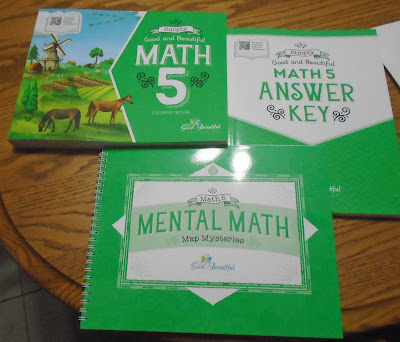
Simply Good & Beautiful Math for Middle School {Review}

Now that our youngest is approaching high school, we are rethinking so many subjects. What worked best before is not necessarily the best fit now. With his special needs, we went off in search of more relaxed and gentle approaches to core subjects, including math...

Simply Good and Beautiful Math was the perfect solution!  Each of these brand-new math courses was created to provide a perfect balance of enjoyable learning along with development of a strong math foundation.  They combine fun games and activities with the highest academic standards, diversity, and connected learning, and we love the way that math is seamlessly linked to real life in engaging and meaningful ways.

I should back up and say that until this point, we have always used Saxon Math - and it is a fantastic course all on its own.  It definitely prepared my boys for higher learning, using a spiral method of mastery that included DIVE videos, and providing a great foundation for math skills.  It's an older program, but it works well.  Why reinvent the wheel?

Why indeed?  Well, because our youngest son learns quite differently, and needed something more visual.  Saxon math is a black and white program - all the way around - and it just wasn't working as well for him.  As we bridge into advanced concepts and look toward algebra, it has become very important to make sure he masters the foundational skills in a way that works for him.

The course includes a course book, Mental Math Map Mysteries, the answer key, and access to course videos.  The student has the option of reading a mini-lesson or watching the course videos, but I find he does best by doing both.  We start each lesson by watching the video, completing a couple of problems alongside the video, and then we complete the mental math together.  For the first time ever, math class is something he looks forward to!  I'm guessing that one of those reasons is because it's hard to be the baby of the family, and he knows that for ten minutes each day, the two of us will sit together, doing the mental math book as a team.

The course book features simple daily lessons, with a format including enjoyable activities and games. Advanced multiplication and division, geometry, graphing, measurement, and so much more are all taught. This book serves as both the teacher’s guide and the student book, and it guides parents and students through each engaging lesson.

The Mental Math Mysteries book is set up for you to sit face to face with your child.  He sees the side with the questions, and you see the side with the answers.  At the end of each page of four or five lesson boxes, the student is directed to place a sticker onto their included map.  At the end of the course, the student will have a completed picture of the map, and as a reward for completing the course, the child is then able to read the “You-Choose” book included in the course: Ivy and the Ice Village.

Admittedly, I wasn't keen at first to scrap the materials we already had on the shelf and purchase a new curricula.  After all, while it's common to go round and round searching for the right curriculum during your first few years of homeschooling, we've been on this train for a decade and have a system that works.  But sometimes, you just have to admit that there is a better way...

What actually swayed me?  Well, it was the visuals.  The course is so visually appealing, colorful, and engaging through multiple games and teaching methods, and this was exactly what our son was needing.  Even the answer key is beautiful!  For a kid who already strongly dislikes math, changing the format to something that at least seems like fun has already made a big difference.  We're only a week into school, but I'm usually hear complaints on day one...and haven't heard one yet!

This course also includes video lessons, which really bring the material to life in a real-world application way...exactly what he needs to answer that "why should I care?" question I'm always fielding.  But that's not to say that it's not a comprehensive, well-rounded book.  There are also graphing exercises, multiplication tables, geometric formulas, and all the things that a good math course needs.

Watch a Video Lesson  Try Sample Lessons Here!

It's a new program, so we'll let you know how it goes at the end of the school year, but so far I'm impressed!

Saturday, August 14

Motivating Your Teens

Once upon a time, before automation became commonplace, teenagers were the working class of our society.  You'd see them in shopping malls, grocery stores, restaurants, gas stations, and other such places working hard alongside adults.  However, thanks to technology, teen jobs have been phased out, leaving them to devote that time and energy to such fruits as video games and texting...

Teenagers are in that middle realm between childhood and adulthood.  They want to be treated like adults, and most would welcome the invitation to take on adult responsibilities.  "Back in the day," they could contribute to society through their after-school and summer jobs, which contributed to their own sense of pride and self-worth.

Teens today have those same desires, to feel worthy and contribute.  However, they often aren't given meaningful opportunities to do so, and they aren't motivated by things that seem trivial or that they can't relate to.   So how do we motivate them?

6 Secrets to Motivating Teenagers

  • Make it Personal

    • If you want to wear clean clothes, you'll need to do laundry.  If you want to drive, you'll need gas money.  If you forget to put the trash can lid on, you'll be picking up trash off the ground.  These are tangible benefits that teens will understand.  It can be difficult to understand WHY some things need to be done, but try to relate chores and tasks to a greater goal.  For example, you have to write this essay because it affects your grades, which affect your acceptance into a post-graduate program, which affect your ability to achieve your dream job.  We all have to do things we don't want to at times; helping your teen find that logical path will help remove some of the resistance.

  • Give Them a Say

    • Remember that feeling of always having to do what someone else told you when you were a kid?  It's not a good feeling, is it?  One phrase we eschew in this house is "because I told you so."  It disempowers our children and turns us into despotic rulers.  (And on the extremely rare occasion we've had to use it - typically in a move-it-life-or-death situation, the kids have perked up and responded!)  Teens are at a pivotal point in their lives, on the cusp of adulthood, and with that comes the need to make their own decisions.  That includes having some say over what they do and how things are done.  Our children have chores that must be done on specific days of the week, but it can be done at any point in the day as long as it's done correctly.  Should they fail to complete the task, or drop the ball, then we're on them the following week.  But just for the one week...because there's nothing more demeaning than continuing to harp on someone after they've recognized and corrected their error!

  • Remind Them...But Let them Fail

    • Teenage brains are undergoing one of the most major transformations of their entire life (second only to that birth-five range).  Because of this, neurons are constantly firing and occasionally things get forgotten.  This is in addition to emotional swirls, extracurricular activities, and #life.  One thing our teens need from us right now is help learning how to organize and create routines, which will help them to remember both the big and little things.  In our house, we have a giant whiteboard for notes and reminders.  If it's important, it goes there first.  The grocery list is on the fridge -- if they drink the last of the milk, they write it on the list.  Granted, this only helps them function as part of the family, but when they fly the coop, we'll be helping them tweak the system to their own personal needs.  By the same token, when it comes to more routine tasks (loading the dishwasher, taking out the trash), we're not going to go behind reminding them constantly.  If he fails to do his chore, there are natural consequences, such as having unhealthy animals, having to hand wash dishes, having to drive the trash to the dump in the car, failing a test, or perhaps even losing a job.  I'd rather them learn from failure here at home, where we can talk it to death discuss it and make a better plan for next time, than out in the big, bad world...

  • Be Realistic

    • I always say to my students (in my writing classes), "How do you eat an elephant?  One bite at a time!"  This is usually in reference to writing long research papers, but the same applies for bigger tasks and projects that teens are facing.  If it seems overwhelming, they're very unlikely to even start on it.  They may not think they can finish, or won't do it correctly, or just simply don't even know where to start.  In this case, we help them break a larger task into manageable pieces.  The more you do this, the more they will be able to begin doing it on their own.  We started years ago -- living on a large farm and telling your teen to mow the yard is a great way to get dumbfounded looks!  So we started pointing out specific regions of the pasture / yard to address.  Fast forward several years...our kids now take on big tasks independently by breaking them down one piece at a time.

  • Incentivize

    • Does your teen do their chores on time every week?  Help out around the house without being asked?  Are you praising the positives as much as you're nagging the negatives?  Using your teen's 'love language,' spontaneously reward him or her with something just to say thank you.  For our boys, this means making sure that in addition to schoolwork, extracurriculars, and chores, they have time carved out every single week for things they want to do...alone.  (We're a bunch of introverts over here!)  But also, once a year, we like to reward them for working so diligently and just being amazing.  😏  (Yes, I'm biased, but they are good kids.)  For one of them, this means a music concert with his dad.  For the other one, it means a chance to see water...preferably the beach.  (This is a huge deal when you live in middle America!)

  • Teens Just Wanna Have Fun

    • And now I'm singing Cyndi Lauper...  But seriously, who isn't motivated by the prospect of fun?  This might include playing games, turning a menial task into a competition (eg, raking leaves into the biggest pile), or just singing along to the radio while working.  And for these Gen-Zers, incorporating technology typically makes tasks more appealing, too...
You may also be interested in How to Engage Your Teen / Tween


Snag a slew of resources in the Homeschool Helpers Bundle!


Covers ten topics to get your homeschool running smoothly!
 
Getting Started
· A Parent’s Alphabet
· Choosing the Right Curriculum for Your Family
· Motivating Your Teens
· Seven Steps to Teaching Work Ethic
 
Special Needs
· Occupational Therapy in Homeschool
· Speech Therapy in Homeschool
· Teaching the Distracted Child
 
Making it Fun
· Game-Schooling – Learning through Play
· How to Snag Free E-Books
· Holiday Foreign Language Fun

Looking for more?  Check out the original Mom’s Bundle and Homemaking & Homesteading Bundle!

Wednesday, August 11

Top Ten Ways to Smoothly Transition Back to Homeschool


  1. Gather your materials ahead of time.
      Start the school year off with everything ready to roll.  Make sure you have the necessary books, library books on hold, and printed materials done and on the shelf.  Pick up all the must-have school supplies for a successful year!  Not sure what you're using yet?  Read curricula reviews for in-depth and honest information from homeschooling moms like you.
  2. Let your kids help choose curricula.  For older kids especially, having some input on their curricula will go a long way toward making the transition back into school easier.  Check out Engaging Your Tween & Teen and Interest-Based Electives for Middle and High School for tips on getting cooperation.
  3. Plan easy meals for the first week.  Spend the weeks just prior to school starting putting together some freezer meals and gathering ingredients for slow cooker meals.  These fix-it-and-forget it starters will ensure that you have healthy, nutritious dinners on the table each night...even when you forgot until the last minute!
  4. Make it memorable.  Take school year photos and complete an All About Me each year to record personal and physical growth.
  5. Kick off each day with a read aloud.  Having a morning time together is a fantastic way to start the day as a family, in a slow, relaxed pace.  This tradition doesn't have to fade away with age...just raise the book level.  We still read to our teens, even in high school.
  6. Take a last-minute vacation.  NOW is our time to shine as homeschoolers!  The parks and museums have emptied out as kids went back to school, but no one is taking spring field trips yet.  It's the perfect time for a short family vacation or museum day.  Find inspiration on our Family Travel page!
  7. Switch it up with a unit study.  Not ready to dive into school head first?  Or maybe you just need a break from the humdrum?  Pick up a book, read together as a family, and work on a multi-modal, hands on unit study!
  8. Don't forget about mom!  Diving into homeschooling will quickly take its toll if you forget to take care of yourself, too.  Schedule some time each week just for rejuvenation...be it a bubble bath, quiet reading time, girls' night out, or whatever replenishes your soul.  Need a book recommendation?  Check out Mom's Bookshelf!  
  9. Farm it out.  Maybe you're great at science, but not so much at history.  Regardless of what you need a bit of teaching help with, you have the choice to pull out your hair or farm it out.  It's more common than you think, especially in the high school years. 
  10. Ask for help.  Snag more great tips and tricks as we head back to homeschool.  We'll be covering Motivating Your Teens and a Day in the Life of a Homeschooled High Schooler.
  11. Bonus - 

BACK TO HOMESCHOOL DEALS

  • Totally F-R-E-E

    • Snag an e-book on Homeschooling the Upper Grades.  This covers a wide variety of topics and issues facing the homeschooling parent of teens. In this FREE book, we are also blessing families with fun goodies!
    • Unlock a World of Adventure with the Free Literature Adventure Activity Calendar!  By incorporating this calendar into your homeschooling routine, you're not only checking off key educational boxes but also ensuring that learning remains a joyous and stress-free experience.
    • Pick up a slew of free resources from all subjects from Productive Homeschooling.  These notebooking pages can be tailored to any age. 
    • Snag free lessons from the Homeschool Made Simple video curriculum, a new series designed especially for homeschool parents.
    • Sign up to receive this semester-long FREE course for high school students on the subject of Psychology.  In this course, they use video and text to take a jaunt through the brain -- how it works, when it gets miswired, and how to cope with those issues.
    • Try out Techie Homeschool Mom unit studies with this Endangered Animal Project, totally free!
    • Pick up the Homeschooler's Delight Bundle, including fun stuff from the vault, product samples, and more freebies…all in one fantastic goody basket!
    • If you use The Good & the Beautiful, bookmark the TGTB extensions page, where you'll find video playlists, extra printables, quizzes and practice tests, and more that homeschooling moms have created and pulled together all in one place!
    • Several fantastic & free downloadable resources from our TeachersPayTeachers store cover everything from core classes to extras for mom!


HOMESCHOOL SUCCESS RESOURCES

Planning & Prepping

Fun Studies

Year by Year

Homemaking Helps