
.jpg)

May 22, 1967 - Langston Hughes shuffles off this mortal coil. His ashes are interred at the Schomburg Center for Research in Black Culture in Harlem.
Langston Hughes was a leader of the Harlem Renaissance and one of the earliest innovators of jazz poetry. Born in Joplin, Missouri (1901), he grew up in the Midwest and began writing at a very young age. As a young man, he moved to New York City, studied at Columbia and Lincoln Universities, and began his career as a writer. His writing was heavily influenced by folk and jazz rhythms, and you can hear these in the 'listen' section below.
Hughes wrote plays, short stories, and poetry. From 1942 to 1962, he wrote weekly columns in a black newspaper, The Chicago Defender, regarding the civil rights movement. He was a source of inspiration for black people during this time, stressing racial consciousness and encouraging African-Americans to embrace their black pride.
The Harlem Renaissance was a time of blooming intellectual and artistic developments in African-American culture. Langston tried to honestly portray black lives, avoiding negative stereotypes, but also diverting from the idealization. He wanted to see black people as people who had difficulties and celebrations just like everyone else.
 Read
Read
- Finding Langston
- It's 1946. Langston's mother has just died, and now they're leaving the rest of his family and friends. He misses everything--Grandma's Sunday suppers, the red dirt roads, and the magnolia trees his mother loved. In the city, they live in a small apartment surrounded by noise and chaos. It doesn't feel like a new start, or a better life. At home he's lonely, his father always busy at work; at school he's bullied for being a country boy. But Langston's new home has one fantastic thing. Unlike the whites-only library in Alabama, the Chicago Public Library welcomes everyone. There, hiding out after school, Langston discovers another Langston--a poet whom he learns inspired his mother enough to name her only son after him.
- Collected Poems of Langston Hughes
Listen
 Watch
Watch
Make / Do
- Start writing your own poetry! Brainstorm with this Picture Inspiration.
- Choose a song, and use this Song Analysis sheet to analyze the lyrics.
- Our cover photo poem is by Darcy Ellington. See more of her work here.
Vocabulary
- drone
- drowsy
- syncopated
- mellow
- dull
- pallor
- weary
- ebony
- ivory
- melody
- sway
- rickety
- melancholy
- tone
- chord
- satisfy
- croon
Think
- How did life in Harlem during the 1920s, 30s, and beyond influence Langston Hughes's work? How did he incorporate the cultural, societal, and political realities of the time into his writing?
- Langston Hughes unabashedly wrote about the hardships faced by Harlemites during uncertain economic and political times. However, he was criticized for oversimplifying his depiction of African Americans and the societal inequities they faced. Do you think his critics were correct in their opinions? Why or why not?
Our Own Poetry
Inspired by Langston, one of our sons took up the pen and created some poems of his own....they're dark, as most teen poems are, but pretty good!
Glittering come clouded skies
That robe the pallor moon
Whose veils of mist lay on her
But yet add to the gloom
For though the clouds are noble
And may halt the sun in day
At night I wish them to depart
And the stars to find their way
Called of night, day brings my bane
herald the fading of the light
light obscures as much as day
so why does only one bring flight
No more say I, should we abide
to endure the days harsh fire
that burns the flesh and blinds the eye
and brings no though but ire
Oh vile sun, the light of life
why pain do you deal me?
to shun me from a life well lived
and not but shadows see
But why should I fail all
for night opened its embrace
it offered me comforts yet unknown
how sweet that lady’s grace
Thusly I embrace the night
and though it always falls
she returns in steady victory
her spears of shadows tall
The empty silence fills my mind
and the road is long and lonely
I don’t know what I cannot find
yet the road is long and lonely
Blissful silence, gentle rest
how needed your repose
but ending come as quickly now
and each day brings new woes
Who can say what is left for me
but to accept my dismal fate
and pray the as I chase this life
I will not come too late
Though I stoic visage give
for the paths that lie before
my heart will shed its silent tears
for that never open door
I am from whiteboads that line the day
I am from deer trails that show me the way
From fields that stretch to the distant sky
In which for ticks I cannot lay
I am from summer its sweltering heat
Which even a night of without sun cannot beat
From the hordes of misquitos and spiders to match
To weeding the ever growing tomato patch
I am from family that lives like the tide
So full then so empty of those by my side
I am from two houses a father and son
Each waxing and waning till ones bell had rung
From a cucumber harvest, a kitchen brine soaked
To the unending figures in that same kitchen I wrote
To the tears that were shed of pain in body and mind
To the gentle caress as my mother was kind
I am the snow of the sawdust clad floor
The old knight pictured upon my door
The ashes of a building burned
The aroma of the rotisserie I turned
I am from the world that was
From days when tech was just because
A life could be made easier yet
And not upon your life you’d bet
This is how I see this world
Through the eyes of one so hurled
At this mach pace through this broken land
Where science rules yet fools demand
We bow to the folly of their lies
To carry them, yet I despise
The touch of falsehood on my lips
Not can I bear take the quips
So silently in protesting quiet
A bleeding tongue so caged and yet
If these lines be never shown
I will see them. Ill have known.
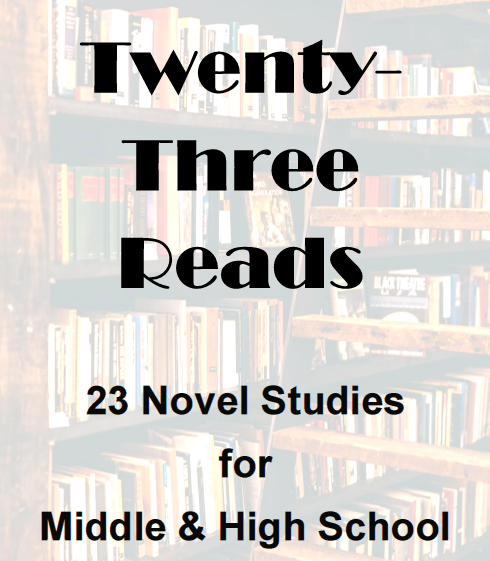
It includes twenty-three unit studies covering a wide range of topics. Each unit has introductory text, which will give the student basic background information about the topic at hand. These studies are directed toward upper grades students, but some have resources for younger students so that the whole family can work together.
Product samples:
Looking for a literature-based language arts program? The Twenty-Three Reads Bundle is for someone who wants a little bit of everything!
It includes twenty-three unit studies covering a wide range of topics. Each unit has introductory text, which will give the student basic background information about the topic at hand. These studies are directed toward upper grades students, but some have resources for younger students so that the whole family can work together.
- There are photographs and illustrations, and we have also included primary documents when available.
- After this text, there are featured videos, which augment the background information and help make the topic more accessible for more visual students.
- You will also find a short list of reading books, including a featured novel that the unit builds upon.
- There are vocabulary words, places, and people to identify.
- Reading comprehension, critical thinking questions, and writing assignments are included.
- We add fun with hands-on activities and extra videos to watch that will bring the era to life.
- Language Arts
- Finding Langston & the Poetry of Langston Hughes
- Geography
- Anne of Green Gables & Canadian Provinces
- Stowaway & Antarctica
- Julie of the Wolves & Alaska
- Blades of Freedom & the Louisiana Purchase
- The Avion My Uncle Flew & France
- History
- Zlata’s Diary & the Slavic Wars
- Freedom Summer & the Summer of 1964
- Treasure Island & Pirates of the Caribbean Sea
- Farenheit 451 & Types of Government
- Red Stars & Russia in World War 2
- The Great Gatsby & the Roaring Twenties
- The Long List of Impossible Things & Post-War Germany
- A Tale of Two Cities & French Revolution
- Witch of Blackbird Pond & Salem Witch Trials
- The World Made New & Early Explorers
- Stitching a Life & Jewish Immigration
- Life Skills
- Teetoncey & Lifesaving Skills
- Freak of the Week & Disabilities Awareness
- Island of the Blue Dolphins & Sailing
- Science
- The Science of Breakable Things & the Scientific Method
- Frankenstein & Human Anatomy
- Charlie Thorne and the Last Equation & Albert Einstein
Product samples:

No comments:
Post a Comment
Note: Only a member of this blog may post a comment.