Click the graphic above to access all our novel studies!!

Monday, July 24

Studying Congo with Inoyo of the Congo Forest


Congo-Brazzaville and Congo-Kinshasa...two African countries with a similar history, but a varied future...

The word ‘Congo’ originates from the Bakongo, a Bantu tribe that lives in both countries.  Congo-Kinshasa (also known as the Democratic Republic of Congo) is the third-largest country in Africa, but Congo-Brazzaville (also known as the Republic of Congo) is very small in both size and population.

Both Congo countries are the perfect place for visitors who love outdoor adventures.   There are several hiking trails, national parks, places to boat, and beaches.  In Congo-Brazzaville, most of the population lives in urban areas, but in Congo-Kinshasa, the large majority lives scattered in the rural regions that are lushly covered in tropical forest.  The indigenous peoples of the region largely include the Bantu and Pygmies, with nearly 200 other ethnic tribes comprising the rest.

Congo History

The countries were once ruled by France and Belgium, and French is one of the official languages of the region.  Aside from Rome and the Vatican City, the Congo capitals - Brazzaville and Kinshasa - are the closest capital cities on Earth.  They sit directly across each other on either side of the shared Congo River.  Both countries gained their independence in 1960, and while their cultures are similar, they began to split in similarity at this point.  

They use different currencies and have different governmental systems.  Congo-Kinshasa (orange on the map) was once known as Zaire.  When it became independent from Belgium, Western countries supported General Mobuto Sese Seko as the leader of the free DRC.  Upon his death in 1997, the region was drawn into a series of military conflicts with its neighbors, known as "Africa's World War."
"The abundance of natural resources in the Congo helps fuel the flames of conflict. In a context in which the population is desperately poor and the government fails to provide even basic services, taking up arms seems to some individuals and communities to be the only way to break through the corruption, patrimonialism, and government incompetence that prevents their accessing the benefits of the abundant mineral wealth in their territory. Competition over resources has been a factor driving conflict, and the exploitation of Congo’s resources by groups linked to Rwanda, Uganda, and other outside interests has provided particular motivation for local militia groups to act to secure economic resources for their communities — or at least for themselves."  (~Global Security)

Colonization History
In 1884, the Berlin Conference was a starting point for partitioning the Dark Continent.  During what became known as the "Scramble for Africa," seven European powers divided, invaded, and occupied most of the land over the next 30 thirty years.  At the time, Europe was experiencing a depression.  Africa had an abundance of raw materials, such as oil, ivory, rubber, wood, and gum, that could be used for profit.  Nearly 90% of Africa was under European control by the onset of World War I.

Learn more about the scramble for Africa in our Things Fall Apart unit study, part of the Advanced Literature Studies bundle.

Dangerous Animals of the Congo

  • Hippopotamus may be an herbivore, but can easily kill a person since it is big, aggressive, and quick, both in and out of the water. It is believed that hippos are responsible for hundreds of deaths every year.
  • Nile Crocodile are large, fearsome predators with the occasional penchant to attack humans who accidentally stumble into their territory, and sometimes even grab fishers in their boats.
  • Puff Adder snakes are responsible for more bites than any other snake in Africa. There is always the danger of someone accidentally stepping on them as they lie in the dirt since they are camouflaged and very toxic.
  • Black Mamba is one of the largest and deadliest snakes in all of Africa. The potent mixture of neurotoxins will directly attack the nervous system. The death rate is quite high in untreated cases.

Read
  • Where is the Congo?
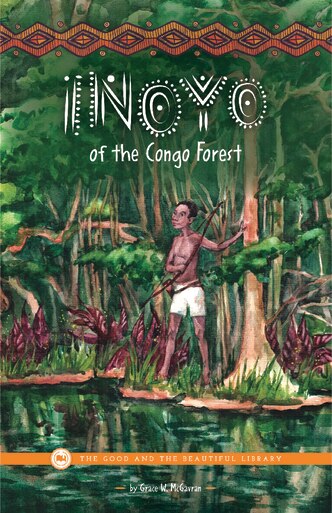
  • Inoyo of the Congo Forest
    • Twelve-year-old Inoyo’s story begins in the dense tangle of the Congo rainforest, where he hunts for food as his father taught him. However, Inoyo has ambitions beyond the jungle—a plan to move to the Christian mission and learn medicine. His father, fearful of breaking tradition and of the tribal medicine man’s disapproval, grudgingly gives his permission. As he works tirelessly to prove his dedication and earn money for his schooling, Inoyo finds himself in a difficult position of choosing to help a friend in need or continuing to pursue his education. Equipped with practical medical knowledge from his time at the hospital and a newfound testimony of Jesus Christ, Inoyo helps to free his family and his village from the shackles of fear and superstition.

Watch
Make / Do
Identify
  • Kinshasa
  • DRC
  • Congo River
  • Zaire
  • Livingstone Falls
  • Brazzaville
  • Mobayi-Mbongo
  • Lake Tumba
  • Lake Mai-Ndombe
  • Katanga
  • bonobo
  • tsetse
  • okapi
  • Lake Tanganyika
Think
  • To what extent did Western influences shape life in the Congo?
  • Why did the witchdoctor in our book vehemently oppose his villagers going to the hospital?


Monday, June 12

Year-by-Year High School Reading Plan

The Good & the Beautiful has an amazing language arts program, and my sons have really thrived by completing it.  Without any further practice or instruction, they've performed well on the ACT reading and grammar portions, too, so I know it's working!

I wanted the kids to have a stronger literature base, however, than just what was included in the program.  Each year, the students read five novels as part of the language arts.  We're a reading household, though, with each of us reading multiple books simultaneously...some for school, some for fun, some for bedtime (and in mom's case, one for the elliptical -- you can find Mom's Books here).  

One question I'm often asked if how we keep the plots separate, but as a long-time, avid reader, it just comes naturally.  I mean, as long as you're not reading very similar books (ie, don't be reading three WW2 books at the same time).  But I digress....

When choosing books to add to the language arts program, we took into consideration the other core classes the kids were doing each year and built a library around those studies.  You guys know I'm a huge proponent of learning through literature -- hence all the novel studies -- and we've been doing that for several years now.

When we first started homeschooling, we used a curriculum called A World of Adventure, which was AMAZING for families who want to do unit studies together.  Honestly, I have no idea why the author quit writing 2/3 of the way through.  Many of the books we used with that curriculum are on the list of fleshed out reading my young son does today as part of his high school.

Broken down by subject, here are our recommend reading list for additional high school studies.  
  • Books that are included in the TGTB Library line are starred.*
  • Books that we have unit studies for are highlighted.   


Ancient History

(Choose six books from different periods)

Medieval History

(Choose seven books from different periods)


Early Modern History 

(Choose eight books from different periods)


Modern History 

(Choose six books from different periods)


Looking for more booklists?  Check out...


Tuesday, May 30

Culper Spies & Women in the Revolutionary War

Whether on the farm, in a tavern, working as a spy, or actively fighting in a battle, women played many roles in the American Revolution...

While formal politics did not include women at this time, everyday actions and behaviors became charged with political significance, and in this way women played an integral role.  The decision to stop drinking British tea or ordering clothes from Britain showed Colonial opposition by patriot women during the years both leading up to and during the war.

For the most post, women expressed their support through traditional gender roles, including home economics and assisting with the businesses of their husbands and fathers.  It should be noted that the war also negatively affected the lives of Tory women, who remained loyal to the crown, and those who remained politically neutral.

Fun Facts:

  • Women and children often followed the army camps, cooking, cleaning, and providing laundry services, as well as assisting in field hospitals and serving as seamstresses to repair clothing, tents, and other materials.
  • Some women disguised themselves as men in order to fight in the war.  Others served as spies during the war.  Women were fairly effective spies, for both sides, because they could pass through checkpoints and camps without raising too much suspicion or drawing too much attention to themselves.
  • Women took care of businesses, homesteads, families, and properties when their husbands left for war.  After the war, like multiple American wars in the centuries after the American Revolution, women were expected to go back to their traditional roles.
  • Women had political influence, but largely through their husbands.  One example is Abigail Adams, who famously and voluminously corresponded with her husband while he was in Philadelphia, reminding him that in the new form of government that was being established he should “remember the ladies” or they too, would foment a revolution of their own.  Learn more about Abi here.
  • It was the women, through personal diaries and narratives of others, who documented the war era.

A Woman Disguised

Deborah Sampson is known for having disguised herself as a man and serving in the Continental Army under the name Robert Shirtliff, fighting in the American Revolutionary War.  She was given the dangerous task of scouting neutral territory to assess British troops in Manhattan, which General George Washington contemplated attacking.  She helped lead infantrymen on an expedition that ended with Tory confrontation, then led a raid on a Tory home that resulted in the capture of 15 men.  At the siege of Yorktown, she dug trenches, helped storm a British redoubt, and endured canon fire.

For nearly two years, she fought, her sex undetected, despite close calls.  However, when she received a gash in her forehead from a sword and was shot in her left thigh, she contracted fever, lost consciousness, and was discovered while being treated in a hospital.  Upon being discovered, she was honorably discharged.  She was the only woman to earn a full military pension for participation in the Revolutionary army. 


Hidden in Plain Sight

Nathan Hale was hung for suspected treason in 1776, and was a wake-up call to the dangers of spying in this war, leading Washington to begin the Continental Army's secret service.  Benjamin Tallmadge headed the service, based on Long Island, New York, and recruited only those men and women he felt he could 100% trust.  This group became known as the Culper Spy Ring.

Only one women is known to have been a Culper Spy.  Anna Smith Strong was said to have aided in the spy ring’s activities.  Her husband had been confined on the British prison ship HMS Jersey in 1778, and she lived alone for much of the war.  She used the laundry on her clothesline to leave signals regarding meeting locations for other spies.

The Culper Spy Ring achieved more than any other American or British intelligence network during the war.  In 1780, it uncovered British plans to ambush the newly arrived French army, and without their warnings to Washington, that alliance may well have been damaged or destroyed by this surprise attack, leading to a completely different outcome for the war.


Read

  • Anna Strong & the Culper Spy Ring
    • It’s a true story of the American Revolution: Meet the secret Culper Ring, a network of American spies fighting against the army of British redcoats, and historical figures like George Washington and the soon-to-be-infamous Benedict Arnold. And meet Anna Strong, an unsung heroine who found ingenious ways to communicate top-secret messages to her fellow spies, helping to save the American colonies from British rule.
    • It’s a mystery to solve: There are clues embedded in the book’s text and illustrations. Spycraft materials, including a cipher wheel, come in an envelope at the beginning of the book. Use them to decode Anna’s hidden message and discover the secret mission she undertook for the Culper Ring!

Extra Reading

Watch

  • Mary Silliman's War
    • It is the fourth year of the War for Independence. The enemy is not only the British--Americans are also fighting among themselves. Mary Silliman's town of Fairfield, Connecticut, is bitterly divided between patriots and tories. When her husband, a fierce patriot and state's attorney, is kidnapped and held for ransom, Mary sets in motion a dangerous plan to win her husband's freedom.
  • Turn (miniseries)
    • Washington's Spies is the untold story of America's first spy ring. An unlikely team of secret agents form The Culper Ring to help George Washington turn the tide of the Revolutionary War.

Make / Do

Identify

  • Mary Ball Washington
  • Martha Custis Washington
  • Lucy Flucker Knox
  • Abigail Adams
  • Deborah Sampson
  • Sybil Ludington
  • Mercy Otis Warren
  • Margaret Moore Barry
  • Elizabeth Burgin
  • Mary Hays Macauley
  • Nancy Hart
  • Esther DeBerdt Reed
  • Margaret Cochran Corbin

Think

  • Why, and in what ways, did the role of women begin to change during the American Revolution?
  • How did the roles of Patriot and Tory women differ?  How were they the same?

Find more Revolutionary Resources

Wednesday, May 17

Take an Adventure through High School Literature!

We LOVE using the combination of a Charlotte Mason / Unit Studies approach to homeschooling. It’s the base of our curriculum, our school days, and all of the novel studies we love to share with you!

The Society of Literary Adventurers is an opportunity for teens to find joy and enchantment in literature with our online book clubs for high school and join an exclusive community of like-minded folks!
Membership includes thirty-eight book units (and more coming), courses on how to write a research paper and a month-long, family-style Christmas unit, printable nature journal and unit study planner, plus several video workshops for parents about homeschooling teens.

 Each book unit includes:

  • Rabbit Trails – Diving off of themes from the novel, meander down paths about pop-culture, history, biographies, poetry, music, and more.
  • Magic Dust - These hands-on projects will take you into the book through science, art, games, and more.
  • Vocabulary & Grammar – Copywork and dictation to help with spelling and grammar, plus literary elements, are included here.
  • Writing Assignments - Covering various literary themes, each book club features a different topic and element for the essay.
  • Party Time! (one per club) – This is the last lesson of each club, and includes ideas for food, decorations, and activities to celebrate the novel.

What's Included?

The Society of Literary Adventurers includes access to ALL COURSES available to high school students.  This includes:

Poetry and a Movie
This course is great for starting high school because it introduces the students to the literary elements. We spend several weeks on each so that the student has a thorough grasp of the concepts.  Each month studies a new poet and includes a new writing project. At the end of the month, your student will watch a movie that used the poem as inspiration.
  • This is a one-year full course with 10 monthly poets.
    • A Study of the Master Poets with Background Information
    • A Study of Literary Elements and Form in the Poetry of the Master Poet
    • A Movie Suggestion to go along with the Poet
    • Writing Instruction
    • Grammar Instruction
    • Fun elements like Poetry Teatime and Trivia Games
Some states require a credit in American Literature. This series was designed to fulfill that requirement.  Each month studies a different classic novel and ends with a celebration of the novel. Each book club also includes a different writing project.
  • This is course is comprised of 10 monthly book clubs. We recommend completing at least 8 book clubs for a full-year credit.
    • A Study of TEN American Literary Classics
    • A Study of Literary Elements
    • A Party School to Celebrate Each Book
    • Lesson Plans for Weekly or Monthly Book Clubs
    • Writing Instruction of Essays and Fiction Stories
    • Grammar, Spelling, and Vocabulary Instruction
    • Fun elements like Rabbit Trails and Magic Dust

British Literature
Some states require a credit in British Literature. This series was designed to fulfill that requirement.  Each month studies a different classic novel and ends with a celebration of the novel. Each book club also includes a different writing project.
  • This is course is comprised of 10 monthly book clubs. We recommend completing at least 8 book clubs for a full-year credit.
    • A Study of TEN Classic British Literary Classics
    • A Study of Literary Elements
    • A Party School to Celebrate Each Book
    • Lesson Plans for Weekly or Monthly Book Clubs
    • Writing Instruction of Essays and Fiction Stories
    • Grammar, Spelling, and Vocabulary Instruction
    • Fun elements like Rabbit Trails and Magic Dust

World Literature
Some states require a credit in World History. This series was designed to be a literature course to complement a World History course and fulfill a language arts credit requirement.
  • This is course is comprised of 10 monthly book clubs. We recommend completing at least 8 book clubs for a full-year credit.
    • A Study of TEN World Literature Novels
    • A Study of Literary Elements
    • A Party School to Celebrate Each Book
    • Lesson Plans for Weekly or Monthly Book Clubs
    • Writing Instruction of Essays and Fiction Stories
    • Grammar, Spelling, and Vocabulary Instruction
    • Fun elements like Rabbit Trails and Magic Dust

These courses can be used as a full language arts program. Each book club course includes grammar, spelling, literary elements, reading and a writing project. All these parts make up a complete language arts curriculum for one year of high school credit.  You can also choose to complete book clubs in your own time frame as a supplement to a language arts program. Use the parts of the lesson which appeal to you and fit with your current language arts program.  We have used the book clubs in both capacities -- as a full year of language arts and as a summer supplement to our Good & the Beautiful curriculum.

How it Works

When you first log into your account, you'll see all of the book clubs available with the course and how far you have progressed on each.  Many of the unit adventures are done via embedded videos and external links to further reading.  What's nice about this is that it's already been pulled together and vetted for you.

Member Bonuses
  • Quarterly Live Workshops
    • Monthly Interactive Book Club - We'll be following a book club together with Daily Planning, Additional Copywork and Dictation instruction and other ideas
  • Printables
    • Downloadable PDF of our Book Club Planner
    • Downloadable PDF of our Nature Journal for use with our Nature Book Clubs
    • Join the Summer Lit Camp, beginning on May 22 with three days of fun with Hobbits, Dwarves, and Elves! Then jump into the summer book club.

Want to try it out?  You can access a completely FREE course from both the Nature Club and the Literature Club for a limited time!  These are aimed at elementary and middle school, but will give you a feel for how the book clubs work.

Saturday, May 13

What We Missed While Homeschooling

As anyone who has graduated a homeschooler knows, senior year is a time for contemplation and reflection.  This journey...it's long, can be difficult, and often leaves you with questions.  Was it enough?  Did I give it the best I could?  Here are thoughts from some veteran mommas...

  • We should have focused more on modern history.  We spent way too much time on ancient history.  More time on US history, Native American history, and modern geography would have helped him more once he got to college.
  • We skipped a lot of grammar in the early years, but it made learning a foreign language incredibly difficult because there was no understanding of verb tenses.
  • I would have focused less on finding a good co-op and just enjoyed the few homeschooling friends we had.  Not every kid needs a wide social circle, and when homeschooling is the only thing you have in common, it just isn't enough.
  • Using an online academy, with a teacher other than myself, helped with preparation for college.  She had to answer to someone else, and I was just 'mom.'  She learned to be on someone else's timeline and how to communicate with a teacher.
  • Even though testing isn't required in our state, a little practice on timed testing would have gone a long way toward helping with SAT prep and probably boosted her score.
  • We spent a lot of time on handwriting, but should have focused more on typing as everything is typed or done on the computer these days.
  • Apps should have been used as a supplement to school, rather than to teach whole subjects.  There are a lot of skills gaps where the app just didn't cover things, but she spent a lot of time playing them.
  • We {I} needed to be more organized about digital curricula, files, paperwork, and keeping up with the transcripts.  It's so much easier to lose digital files than books and paper, but everything is done online anymore.
  • I don't know who needs to hear this, but worry less. Enjoy more. Children grow up so fast, and you can't get that time back. They will absolutely learn what they need when they need it.
  • We should have spent more time on field trips and nature related learning during the younger years, and less time focused on what the kids were "expected" to learn.
  • Although he didn't need to take notes at home, we should have worked on notetaking and making graphs, because these are things he needs everyday in college.
  • We spent so much time switching curriculum, trying to find the 'perfect' one, but there really isn't anything that's perfect.  We should have stayed with one that worked well, and just changed it a bit to make it better for us.  We lost a lot of time, and money, looking for a unicorn.

Organize your desktop easily with these five interchangeable wallpaper designs. Each follows the same pattern, so you can switch out your background while keeping your icons exactly as they are --- easily organized AND visually appealing. The five themes include the four seasons and an everyday wallpaper.  Snag your set!!

Looking for a little extra push?

This book & worktext set will help you and your high school student breeze through the steps of college and scholarship applications, as well as brushing up on study habits and life skills. The worktext includes activities, worksheets, and planning pages, and accompanies the book.

This online co-op provides live / blended classes for high school students, using The Good & the Beautiful for language arts, Apologia / Berean Builders for science, and Notgrass for history.  These classes meet weekly, allowing students the opportunity to discuss the literature, get additional instruction on concepts covered, and show off their art projects and recitations.  Students also to receive a grade for these courses from a source outside of the home.

Pick up the College 101: the First Year ebook for FREE on our Subscriber Freebies page!  Not yet a subscriber?  Sign up here!

Tuesday, May 2

Farming Books for Elementary, Middle & High School (Interest-Led Learning)

One of our sons is more the hands-on, outdoors type of kid.  He works hard and has great work ethic, but doesn't really plan to continue schooling beyond graduation.  He's not a fan of reading, but enjoys reading about working with animals and the land.  If you've got a kid like this....this list is for you!

Farm & Homestead Books for Elementary School

Lower Elementary


Upper Elementary

Caddie Woodlawn
Diary of an Early American Boy
Heidi

--> Download & Print the Farm Book List <--

Farm & Homestead Books for Middle & High School


Check out for our 2023 Word of the Year -- it has something to do with homesteading!


You may also like...

Arts & Crafts: Seed Art

Using pumpkin seeds, corn, peas, wheat berries, or any other hard seed, create your own nature art!  You'll need seeds, glue, construction paper, paint, and a little creativity.  (Parents should supervise younger children as small seeds can be a choking hazard.)


Build Your Own Homestead Little Learner’s Homestead Science

This elementary curriculum is an interactive homeschool curriculum that will introduce your child to small scale farming. This one of a kind homestead curriculum is designed for pre-school through to 3rd or 4th grade depending on your child and whether this will be used as a full curriculum or supplemental to another curriculum.  

Build Your Own Homestead is designed to give your child a better understanding of where their food comes from. This allows them to take ownership in providing food for the family whether that’s understanding what they are choosing at the grocery store, helping you tend to the garden, or gathering eggs from your chickens.  Homesteading is a science on multiple different levels. Agriculture, animal science, food science, experimentation, and social science are used everyday on the homestead.
*Homestead NOT required*


For more on homesteading, check out the Homesteading Course at SchoolhouseTeachers!

This homeschool homesteading course is designed for anyone who has a desire to live more independently and prepare much of what is needed each day using their own hands. In this elective course, the student can learn how to work for what they want by making it themselves, instead of participating in an “on demand” society. Homeschool students of all ages learn patience, along with the skills needed to make their own cleaners for the home, sunscreen, homemade ketchup and dry mixes, as well as how to choose animals and prepare for emergencies, and much more. Learning the patience and usefulness of “doing it yourself” can be immensely helpful not only in the sense of living a healthier life, but also for the budget!

Monday, January 23

Mary, Bloody Mary {Young Royals Lit-Based Unit Study}

Born in 1516, Mary Tudor experienced many hardships during her youth and formative years.  The eldest daughter of Henry VIII, she was staunchly religious and a devoted Catholic.  Her childhood and religious beliefs guided her during her years as Queen...earning her the nickname "Bloody Mary."


Legacy of Mary's Reign & Religious Strife

Mary was born of Catherine of Aragon, Henry VIII's first wife.  She was declared illegitimate in her youth when her father married Anne Boleyn (see Anne's unit).  In her youth, she was shunned, forcibly kept from her mother, and even locked in the Tower of London.  Her younger half-brother, Edward VI, succeeded their father at the age of nine, but died from consumption before he could truly rule.  Upon his death, Lady Jane Grey became Queen for a mere nine days.  Mary gathered the backing of her supporters, of which there were many, and beheaded Lady Jane.  

Mary campaigned for Queen as wanting freedom of religion, but quickly changed her stance.  England had, at one time, been under Catholic rule.  The priests held as much power as, if not more than, the royal family.  King Henry VIII had broken away from that Roman Catholicism, primarily because he wanted a divorce the religion would not grant, and created his own church - the Church of England - with himself at the head.  He punished those who would not convert to Protestantism and accept his rule.  After his death, Mary reverted the country back to Catholicism, and she became famous for killing Protestants who would not convert to Catholicism.  After her death, in 1558, Queen Elizabeth I reversed the religious decree once again.

Betrothals & Royal Marriage

Intermarriage, or the practice of members of ruling dynasties marrying into other reigning families, was very common in the past for political and diplomatic reasons. Put simply, it's hard to go to war with your wife's father. This was the tradition for most of Europe from the medieval era all the way until World War I. Around the world, there is evidence of royal intermarriage as far back as the Bronze Age.  Kinship by marriage could secure an alliance between two ruling powers, hopefully helping to reduce the sense of threat. It could also help to expand a dynasty, through colonization or inheritance.

Royals were often betrothed at a very young age. Parental figures arranged marriages that they hoped would create strong alliances. It was not just young women who were betrothed, and they did not actually married until they reached "adulthood," as defined by the culture. Young Louis XIV and his wife were betrothed as very young children, although they did not get married officially until many years later.


Falconry

When Mary is a young girl, she practices the art of falconry.  Falconry is when you use a raptor, such as a falcon, hawk, or eagle, to pursue live prey (rabbits, squirrels, small birds, etc).  While it is both a sport and a hobby, it is also a bit of a lifestyle, because you must tend to the birds every day, unlike a rifle or bow and arrow, which can both be put away until you are ready to hunt again.  If you are interested in learning more about raptors, see Guide to Raptors.  Want to try it yourself?  Learn how to become a falconer today.


Tower of London

On the north bank of the River Thames in the heart of London is the Tower of London.  Originally known as the White Tower, and built by William the Conqueror after the Norman Conquest, it has been historically known as a prison.  When it was first built, it was a royal residence, but after several periods of expansion in the 12th and 13th centuries, it is now a complex of several buildings set within two concentric rings of defensive walls and a moat.

Over the years, the tower has served as a treasury, armory, home of the Royal Mint, a public records office, and the home of the Crown Jewels.  During the 15th through 17th centuries, the tower was most prominently used as a prison.  Today, you can visit the Tower of London and step through history to see it as it was in each century.  Can't get to England?  Take a video tour.

What came just before this?  Learn more in A Loyal Foe & Wars of the Roses


Read

  • Mary, Bloody Mary - The story of Mary Tudor's childhood is a classic fairy tale: A princess who is to inherit the throne of England is separated from her mother; abused by an evil stepmother who has enchanted her father; stripped of her title; and forced to care for her baby stepsister, who inherits Mary's rights to the throne. Believe it or not, it's all true. Told in the voice of the young Mary, this novel explores the history and intrigue of the dramatic rule of Henry VIII, his outrageous affair with and marriage to the bewitching Anne Boleyn, and the consequences of that relationship for his firstborn daughter. This is a historical novel about love and loss, jealousy and fear--and a girl's struggle with forces far beyond her control.
  • Tudor Boy Spy - Thomas Snoop is in training to become a spy. Entrusted with a top secret mission by the mysterious Lord Severn, right-hand man to the Tudor king, Thomas must travel to the magnificent Goldenhilt Hall - in the guise of a servant - in order to uncover traitors plotting against the crown. It will take all Thomas's wits and cunning to uncover the traitors lurking at Goldenhilt Hall - and he must do so without being discovered himself... Filled with amazing facts and historical trivia, you won't be able to put this secret diary down!

Watch

Make / Do

Vocabulary

  • monarch
  • armada
  • execution
  • reign
  • vagrancy
  • treason
  • War of the Roses
  • heir
  • Tower of London

Think

  • What were the long-term consequences of what has been described as "England's Terror"?
  • Listen to this primary source document (read aloud).  What did people think of Mary?  Did they want her to be Queen?  Having read the book and studied history, why do you think this is?


Get the entire Young Royals bundle!

Includes seven unit studies covering the entire series. Each unit addresses a historic era from the eyes of a young royal, and these are told in living history format.  Each unit has introductory text, which will give the student basic background information about the topic at hand.
  • There are photographs and illustrations, and we have also included primary documents when available.
  • After this text, there are featured videos, which augment the background information and help make the topic more accessible for more visual students.
  • You will also find a short list of reading books, including a featured novel that the unit builds upon.
  • There are vocabulary words, places, and people to identify.
  • Reading comprehension, critical thinking questions, and writing assignments are included.
  • We add fun with hands-on activities and extra videos to watch that will bring the era to life.
These studies are directed toward upper grades students, but some have resources for younger students so that the whole family can work together. Our family has used unit studies as curriculum for many years, and we hope that your family will enjoy these, too!

Product samples:   Mary, Bloody Mary

Includes:
  • Mary, Bloody Mary
  • Beware, Princess Elizabeth
  • Doomed Queen Anne
  • Patience, Princess Catherine
  • Duchessina: Catherine De'Medici
  • Wild Queen: Mary, Queen of Scots
  • Bad Queen: Marie Antoinette