Click the graphic above to access all our novel studies!!

Thursday, November 21

Hold the Wrapping Paper! Easy-Peasy Gift Bags

One of my biggest hang-ups about the holidays is the sheer amount of trash generated!  We began using reusable gift bags several years ago, and have seen the trash cut down considerably...  

They're very simple to make, don't cost very much, and I encourage you to give it a shot!  You're not limited to holidays, but can use these for birthdays and other occasions.  You're only limited by your imagination....

To keep costs down, we visit the local craft store and pick up remnants.  These are the bits of cloth leftover, each less than a yard long, from the bolts of cloth in the store.  You can find just about any type of cloth - from fleece to sheer - and any print!  Below, we have one for holidays and one for birthdays.
Unroll the fabric and run it through the washer and dryer.  This will prevent it from shrinking later.  Then fold it in half.  Determine how large you want your bags to be, and cut out rectangles that are 1" larger and 1" wider (this is room for your seams) than your desired size.
Fold the fabric 'wrong sides to wrong sides' (meaning that the pretty side of the fabric is inside), and run a straight stitch about 1/2" from the edge all the way down three sides of the rectangle.  Your fold might be one of those sides...leaving you only two sides to sew.  Make sure to leave the fourth side open so that you can put your hand inside!
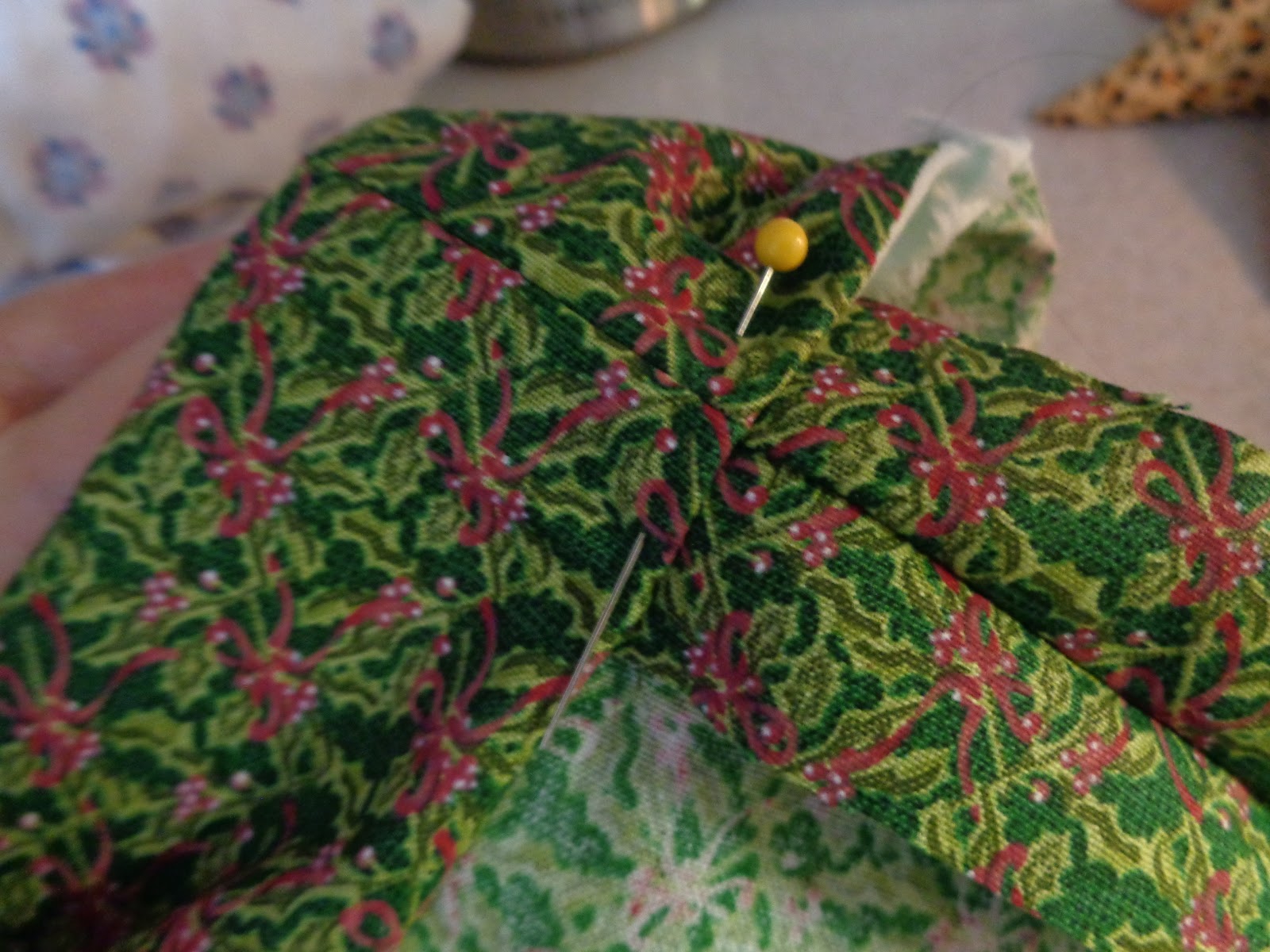
Keeping your fabric wrong-side-out, let's work on that fourth side...the one you left open.  Fold down the top of the fabric 1/2", then fold it again 1/2" so that the raw seam is tucked inside against the 'wrong side' of the cloth (you'll have three layers of fabric here).  Do this all the way around that fourth side, being sure to pin it down every few inches.  
Run a straight stitch around the bottom of that fold (careful not to run over the pins!), leaving a 'pocket' in the fold to run a ribbon or string through.    Leave a 1" opening, where you do not sew it shut, for your ribbon.  (Alternately, you can sew it completely shut, and then make a small hole later at the top of this pocket.)
Turn your rectangles right-side-out.  Some people choose to iron these flat for a neater appearance.  Since they were going straight to a kids' birthday party, we opted against it.  Select your ribbon or string for closure.  A pretty ribbon classes up the bag.  A hemp string gives it a rustic look.  In a pinch, some yarn from the craft box will suffice, too!
Run the string through the opening you left in your pocket at the top of the bag.  This is very important....tie it to a paper clip or safety pin!  (You want to keep a hold of the string to get it all the way around the opening.)  Tie the string, and slide it around so that the knot is hidden - or make it a beautiful, showy tie that you want seen.
Here are the two bags that we made in less than fifteen minutes, ready to roll for a party!  They are simple and quick.  Above are bags that our family keeps and reuses year after year.  The ones made out of old jean legs have been painted and decorated for extra flair.  You're only limited by your imagination!!

Wednesday, November 20

Serafina and the Twisted Staff + A Gilded Age Christmas unit study

With the advent of our Roaring 20's New Year's party, we're finding all sorts of ways to incorporate late 19th / early 20th century history into our studies.  Here is a Christmas unit study, easily tailored up or down for all ages, that begins with a mystery in the heart of the Blue Ridge...

What to Read
  • Serafina & the Twisted Staff - set against a backdrop of Christmas at the Biltmore House, Serafina and Braden must solve the mystery before it ruins the holidays!
  • A Victorian Christmas Collection - a compilation of cookbook recipes and newspaper articles related to American Christmas cookery, holiday customs, and stories spanning from the 1850s through the 1890s.
Music Appreciation
  • Vintage Christmas Songs from the 1900's & 1910's Medley (compilation)
    • With nearly an hour of vintage classics, this holiday set will get you in the mood to celebrate Christmas in the old-old-fashioned way!
  • Vintage Christmas Songs from the 1900s and 1910s -- stream the audio below


Classic Literature (Reading Comprehension)
In The Gift of the Magi, O'Henry brings us into a working class home to see the hardships, holiday customs, and lifestyle of this era.  Listen to the story, then complete the comprehension pages below.
At the Top and Bottom (History)
During this era, as decorations, gifts, and traditions became more elaborate and more expensive, the holiday took a more materialistic turn, beginning to push the merchandising over the religion.  'The Gilded Age' was a term Mark Twain used to show the great divide between poverty and opulence in America.  He said that the wealth and extravagance gilded (masked) the poverty and corruption.  It was an era of great contrast...

In Seraphina and the Twisted Staff, and in the video below, we get elaborate descriptions of the opulence seen at the Biltmore Estate.  Read a vivid description of Christmas in the Lower East Side Tenements of New York City, and watch the video below.  While it's easy to relive and appreciate the glorious parts of the upper crust holiday, we must remember that only a small percentage of people lived that way.  Many more celebrated in impoverished conditions, though it did not dampen their spirits.  
    Decorations & Gifts (Math)
    While they were brought to America by German immigrants, Christmas trees only became popular after Godey's Lady's Book published a photograph of Queen Victoria and her family gathered around the tree in 1850.  Suddenly, all of the stylish families wanted their own tree!  By 1900, most homes had floor to ceiling Christmas trees that were lit by candles.  Some families, such as the Vanderbilts, used electric lights on their trees at the turn of the century.

    One simple decoration for the trees was strung cranberries and popcorn garlands.  Using a needle and waxed string that was knotted on one end, they could pierce the kernels and berries to make a beautifully-colored pattern that contrasted with deep green of the tree.  It was only after lady's magazines began to showcase various tree decorations that Christmas ornaments, as we think of them today, began to become popular.  Ornaments, such as glass balls and cut tin shapes, were imported from Germany.

    Harper's Bazaar Magazine published, "Love is the moral of Christmas...what are gifts but the proof and signs of love!"  Gift giving came to symbolize the importance of a relationship.  Those who were closer to the gift-giver, or who the gift-giver revered more, were lavished with larger gifts.  An 1894 newspaper advertisement suggested to shoppers that, "while busy buying things for Christmas, think of other children who are less fortunate than your own."  Stores would sell marked-down goods to be given to the poor as an extension of Christian goodwill during the holiday season...and thus the Angel Tree was born.  This was an attempt to dissension between religion and materialism.

    Complete these math problems:
    • You have 300 cranberries and 525 kernels of popcorn.  Design a pattern for your tree garland that uses all of the pieces.
    • Your family bought a 106" tall tree.  How much will you have to cut off the bottom for it to fit in your parlor?
    • Glass balls are 3c each, and tin shapes are 2c each.  Using exactly one dollar, how many of each ornament will you buy to decorate the tree?
    • Using the Macy's Mail-Order catalog, plan on Christmas gift purchases for your family with a total budget of ten dollars.

    Christmas Recipes (Home Ec)
    Figgy pudding, of the 'oh bring us some figgy pudding!' fame, originated in 14th-century Britain as a way to preserve food.  It was originally served as a fasting meal in preparation for the Christmas season.  Interestingly, the dessert was banned in 1647 by Puritans, but reinstated as a Christmas tradition by King George I.  The recipe became standardized in the 19th century, and resembled our modern-day version.

    Ingredients

    • 12 dried figs, chopped
    • 1/2 cup raisins
    • 1/2 cup water 
    • 1/2 cup orange juice
    • 1 1/4 cups all-purpose flour
    • 2 teaspoons baking powder
    • 1 1/2 teaspoons cinnamon
    • 1 teaspoon ground ginger
    • 1/2 teaspoon ground nutmeg
    • 1/4 teaspoon ground cloves
    • 1/4 teaspoon salt
    • 3 eggs
    • 1 cup brown sugar
    • 2 cups plain bread crumbs
    • 1/2 cup unsalted butter, melted
    • 1 cup dried cranberries
    • 2 cups whipped cream (optional, for serving)
    Directions
    • In a small sauce pan, add chopped figs, raisins, water, and orange juice and bring to a simmer. 
    • In a separate small bowl, whisk together flour, baking powder, cinnamon, ginger, nutmeg, cloves, and salt.
    • In a large bowl, whisk together eggs, sugar, bread crumbs, and melted butter. Once combined, stir in fig mixture (let it cool slightly) and dry ingredients.  Use a flat spatula to fold cranberries.
    • Butter a large Bundt pan. Add a few cups of water to another pan that is large enough to hold the Bundt pan. Place the Bundt pan into the larger pan (like a roasting pan) and make sure the water comes at least halfway up the side of the pan. Adjust water levels accordingly.
    • Scoop thick pudding batter into buttered Bundt pan, smooth it out, and cover with foil. 
    • Cover and bring water in larger pan to a simmer, reduce heat to low and let pudding steam for 2 hours. Check water levels every 30 minutes or so.
    • After steaming, let the pan cool and then remove it from the water bath. Remove foil and flip it over so pudding comes out.
    • Slice and serve with whipped cream!

    Letters to Santa (Writing)
    ... there would be no childlike faith then, no poetry, no romance to make tolerable this existence ... Nobody sees Santa Claus, but that is no sign that there is no Santa Claus. Nobody can conceive or imagine all the wonders there are unseen and unseeable in the world...  ~Yes, Virginia, There Is a Santa Claus


    If you've ever confused Father Christmas and Santa Claus, you're not alone!  They are actually two separate stories.  Father Christmas was a sign of returning spring, and usually dressed in green and showed up at midwinter festivals.  Our modern-day Santa evolved when the Dutch immigrated to America, as they brought Sinter Klaas and his holiday gift distribution!  Thanks to C.C. Moore's 'A Visit from St. Nicholas,' children had visions of sugar-plums and lots of Christmas hope and dreams!  

    Pretend you are a boy or girl of the late 19th century.  Write a letter to Sinter Klaas.  Try to make it about a page long.
    Snowball Dinner (Arts & Crafts)
    The Victorian Christmas dinner often had a separate table for children that was adorned with special, whimsical decorations and gifts.  The table's centerpiece was a large snow globe filled with hidden gifts.  Candles tied with ribbon led from the snow globe to each plate, leading each child to his or her surprise!
    To design your own snow globe centerpiece:
    • Cover a hollow globe (or round fishbowl) with cotton batting.  
    • Set it inside a wreath laid flat on the table.
    • Place a small gift inside for each child.  Tie each gift to a long ribbon.
    • Fill the opening of the globe / bowl with holly and mistletoe.
    • Decorate the table with pretty holiday dishes.  They make disposable holiday dishes, if you're not sure about letting them use the good china...
    • Place the other end of the ribbon underneath the plates.  (One ribbon goes to each plate.)
    • Let the children choose where to sit, and that decides their gift!

    Friday, November 15

    Safely Saving those Thanksgiving Leftovers

    Whew!!! You put in the effort and did a slew of holiday baking for the family…now you have enough leftovers to feed an army! But they don’t have to go to waste… Read on for a guide of what to freeze, and how to freeze it...


    Teaching types will also want to check out this Charlotte-Mason style Thankful activity bundle....these morning time plans will make your gentle learning a delight for this season of gratitude and reflection!


    Uncooked stuffing

    • Freeze for: Three months. Shape into one-inch balls, then open-freeze on a tray lined with baking parchment. When frozen, transfer to a ziploc bag.
    • Bake from frozen, adding 10 mins to the cooking time. Ensure they are hot through to the center before serving.
    Homemade sauces (including cranberry)
    • Freeze for: Three months. Once cooled, transfer to ziploc bags, seal firmly and freeze in a flat layer on a baking tray. Once frozen, remove the tray and put the sauces back into the freezer.
    • Defrost by placing the bag in a bowl of lukewarm water until defrosted, then reheat until piping hot.
    Fresh herbs
    • Freeze for: Two months. Finely chop soft herbs and place in ice cube trays, top up with water and freeze. Woody herbs can be frozen whole in ziploc bags. Tie rosemary, bay leaves and parsley stems together.
    • Don't defrost. Use from frozen.
    Egg whites
    • Freeze for: Six months. Place in ziploc bags and freeze in a flat layer (see homemade sauces, above). Label with the quantity of egg whites.
    • Defrost at room temperature
    Milk (skimmed and low-fat only)
    • Freeze for: Three months. Freeze in the container, but pour off roughly an inch of milk first as it will expand in the freezer.
    • Defrost overnight in the fridge. 
    Bread
    • Freeze for: One month. Place in a large bag or wrap well in cling film.
    • Defrost at room temperature.
    Raw processed meats (including sausages and bacon)
    • Freeze for: Three months. Freeze in the packaging or transfer to ziploc bags. Freeze bacon in 3-4 rasher packs – perfect for bacon sandwiches.
    • Defrost overnight in the fridge.
    Cooked vegetables and soups
    • Freeze for: Three months. Freeze in plastic containers or bags; ensure any chunks of meat are well covered by liquid.
    • Defrost overnight in the fridge or place container in lukewarm water until defrosted. Heat until piping hot.
    Potatoes
    • Freeze for: Four months. Once cooked and cooled, freeze mash in tubs, gratins in freeze-proof baking dishes and open-freeze roast potatoes on a tray until frozen solid, then tip into food bags.
    • To defrost, cook roast potatoes from frozen, but defrost mash and gratins overnight in the fridge.
    A few more tips...
    • It’s important to label frozen foods with the contents and date they were frozen. Sticky labels often come unstuck in the freezer, so pop labels inside the food bag.
    • Never re-freeze frozen food (unless it’s been cooked into another dish) – this can encourage bacteria to multiply to dangerous levels.

    Thursday, November 14

    Roadschool Trip to Oklahoma City

    The closest city to our little homestead, Oklahoma City offers some great opportunities in the fields of science and history!  We spent a week exploring the city, learning about the land rush, fossils and skeletons, Native American history, cowboys, and a lot more!  Come join the fun!

    Museum of Osteology
    Bones are a fascinating topic in this house!  Whenever we find a dead animal on the property, the first thing that the kids want to do is dissect it and check out it's bones (which occasionally gets to happen, depending on safety).  

    When we go for nature walks and stumble across a bone, it comes home with us until we can identify it.  Once, my son actually found a fossil, which a museum told him was either a tooth or a claw!!

    The Osteology Museum in Oklahoma City is the largest collection of bone-related exhibits in America.  It's unique exhibits are a great tool for teaching anatomy, biological history, adaptation, or classification.
        
     
    I love this caption!

    Dinosaurs & Fossils
    Harn Homestead
    As we approached the anniversary of the Oklahoma Land Run (April 22, 1889), we spent a few weeks at home learning about Oklahoma state history.

    We culminated our studies with a co-op trip to the Harn Homestead in Oklahoma City.  Here, the kids learned about life in the 19th century and homesteading, and they re-enacted the Land Run.  I was surprised at the strategizing! 
       
    One worked with a friend to capture side-by-side plots covered in trees and a river.  The other took a nearby plot with a tree.  When asked about the choice, I received this reply : "Well, I have trees to build a house and barn, and my brother has water.  I'm sure he'll share with me."  Once they were settled, it was time to start tackling everyday chores and schoolwork.
     
    Oklahoma Land Run Activities

    Sam Noble Science Museum
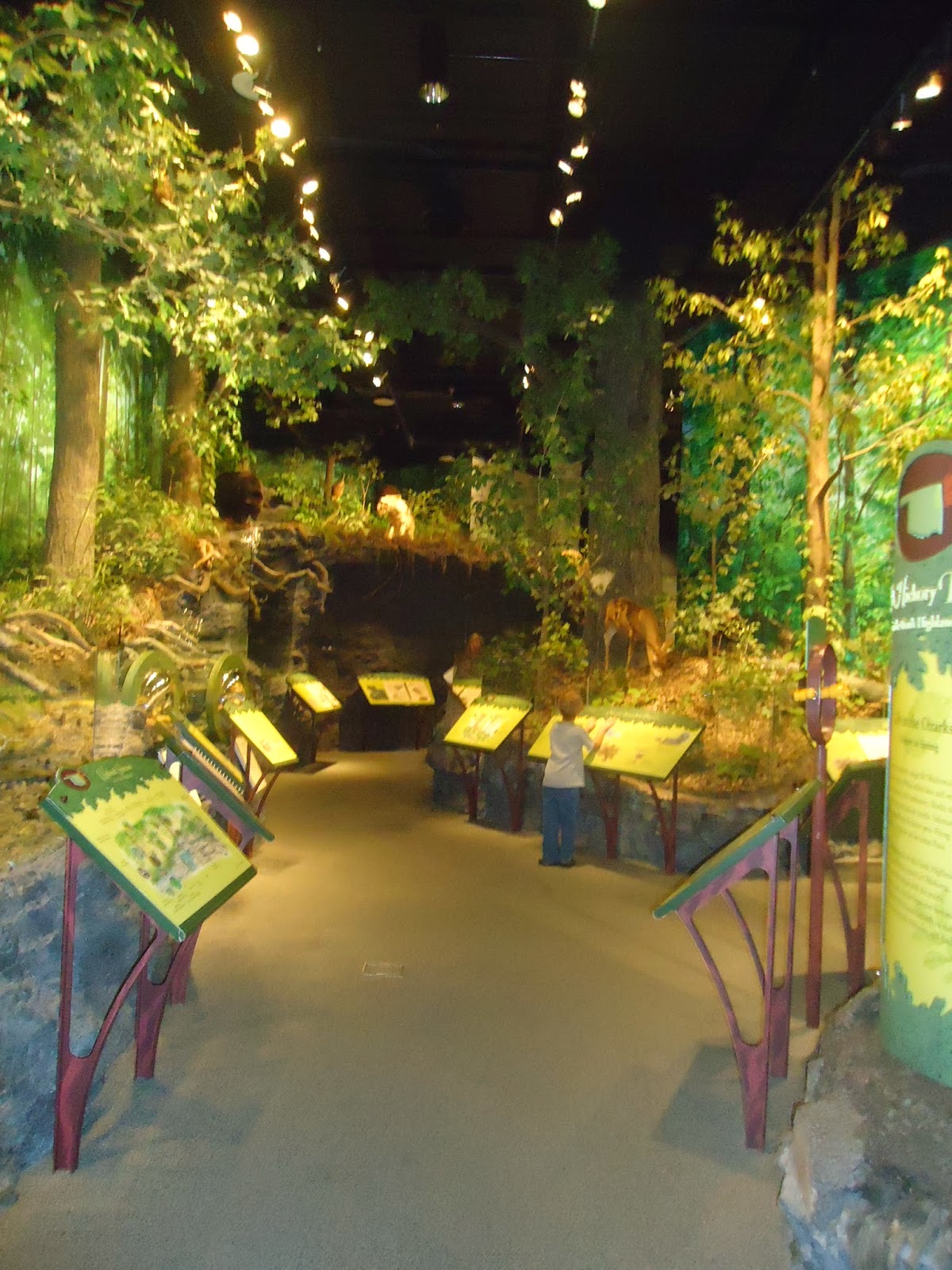
    At the Sam Noble Museum of Natural Science in Norman, there are extensive exhibits on dinosaurs, Native Americans, early Oklahoman history & ecology, and early world history (my son's favorite is the Permian Period, for some reason).  

    There are usually a couple of travelling exhibits as well.  While there, stop by the Discovery Room, a completely hands-on area for kids to further explore the concepts from the exhibits.
       

    Omniplex
    The new Curio-City section of the museum is awesome!  I can't even begin to put into words the collection of exhibits they have in this huge Walmart-sized center of the building.  If you go for no other reason than to visit this area, your trip will have been worth the while.  The gist of it is that it's set up like a city, and each building is a new exhibit.  We're playing around at the radio and television stations in these photos...
    Since there weren't a lot of people in the Tinkering Studio, the guys that worked there let them come behind the scenes and learn how to use the laser printer.  They got to design these cute bats on the computer program, and then watched them being laser cut by the machine.  Then, they got to take them home!  Of course, on the way home I had to explain why we couldn't get our own laser printer...
    The little one doesn't care so much for things that go boom, so while the big one attended a Live Science show (they're free), we explored the art section and took a flight in the space capsule.  I'd like to add that this photo was snapped about a second before he freaked out.....if you have a child with sensory issues, please be aware when putting him / her inside the capsule!
    Finally, what trip to the science museum would be complete without a spin on the little scooter thingy and a visit to the dinosaur section??  If you live in Oklahoma, make sure to schedule a field trip here this year!

    Finally - what Oklahoma unit study would be complete without a little info on cowboys?!  Check out more with our We Were There on the Chisholm Trail novel study.

    Cowboys Resources
    Literature

    Hands-On Activities

    Tuesday, November 12

    Christmas in England & The Other Side of the Wall

    Come December, we love to dive off into a holiday-based unit study!  Putting our regular studies aside, we tackle a topic from the holiday perspective, incorporating reading, math, history, home ec, and crafts.  In The Other Side of the Wall, we are transported into the magic of London at Christmas....where the imaginary seems real and wishes might come true!

    Download Home for the Holidays for three complete units + lots of holiday homeschooling extras!

    What to Read
    • The Other Side of the Wall – 
      • It's Christmas break and Tess and Max are in London, staying at the posh Sanborn House with their Aunt Evie. As they wait for their parents to arrive, there is an unusual snowstorm that makes the city seem as if it's caught in a snow globe. Perfect weather for an adventure in Hyde Park. But when Max, Tess, and Aunt Evie leave to search for a cab, they find a horse and carriage and driver curiously waiting for them at the curb. And that's just the beginning...  Soon Tess is charmed by a mysterious boy named Colin who lives at the hotel all year round--on the 8th floor. But Max is sure the elevator only had 7 floors the day before. And how come everyone at the hotel seems to ignore Colin? Things seem to get stranger and stranger. There's a 1920s costume party in Colin's parents' apartment. A marble that seems to be more than it appears. And a shadow that passes mysteriously by Tess and Max's hotel window.  Tess wants to figure out what's going on, but finds only more questions: Is it just a coincidence that Colin's last name is Sanborn, the same as the hotel? Why does the cat's-eye marble look eerily similar to the crystal at the top of their hotel room key? And, most importantly, what happened in that hotel one Christmas long, long ago?  
    • Christmas in England - Come explore the sights and sounds of the many English traditions that bring people of this country together at Christmas.
    • The Christmas Eve Ghost - In 1930s Liverpool, where streetcars clang on iron tracks, young Bronwen and Dylan live with their widowed Mam.  This is a story of community and kindness.
    • Letters from Father Christmas (J.R.R. Tolkien) - A charming collection of the letters Mr. Tolkien wrote to his children each year for Christmas as they were growing up. Each story is told from the perspective of Father Christmas himself!

    Music Appreciation

    Classic Literature (Comprehension)
    Traditions (History)
    Although we generally think of Britain as being one country (England), it can also describe the United Kingdom. The UK includes the nations of England, Scotland, Wales, and Northern Ireland. Several smaller islands are also included.  The first recorded use of the word “Christmas” was in 1038 when a book from Saxon England used the words “Cristes Maesse” in it.

    Many of the traditions practiced today come from Britain's ancient past. Under the Romans, December had a festival called Saturnalia.   King Alfred was the first king to enforce the observance of the twelve days of 'Christ's Mass' according to church law.  This time of year was known as 'Nativity', 'Mid-winter,' or Mid-Winter Mass' up until 1043.

    Medieval traditions in Britain may seem odd to us today, but they’re actually the basis of many of our traditions today. Several of our Christmas carols came from this era, as did the tradition of caroling.  "Carol" meant to sing and dance in a circle, and that is what people were doing in church services, so they were banned to the streets.  We still carol in the streets from house to house today!

    Two of the oldest surviving carols are The Holly and the Ivy and I Saw Three Ships. Another tradition is Boxing Day on December 26th. This is a bank holiday in the UK nowadays. It originates from the tradition of churches breaking open their alms boxes to distribute to the poor.  The money was put into hollow clay pots with a slit in the top.  They had to be broken to get the money out, and were nicknamed 'piggies.'  This is where we get the piggy bank!


    Decorations & Gifts (Math)


    Complete these math problems after watching the video above:
    • If postage is 54 cents per letter, how much will it cost to mail 16 letters to Santa from the United States?  How much will it cost in England?
    • Mum is making stockings for each child.  Each stocking requires 3/4 yards of material.  How much material will she need to make five stockings?
    • How many prizes and jokes will you need to fill 237 crackers for your school class?
    Christmas Recipes (Home Ec)
    Christmas dinner is very important. It is usually served at around 1 O’clock in the afternoon but varies from family to family. Some people like to have it over and done with in time for the Queen's speech at 3pm.

    Find more recipes in Christmas with Dickens - From Mrs Cratchit’s plum pudding to Mr Pickwick’s "mighty bowl of wassail," Charles Dickens's novels and other writings are alive with examples of good food being enjoyed in good company. In this selection of Victorian classics, updated for modern cooks, you will find old favorites for Christmas dinner such as roast fowl with tarragon, plus recipes for entertaining, such as lobster patties and a Charlotte Russe. There’s even a recipe for a hand-raised pork pie to keep in the pantry for unexpected visitors (or escaped convicts.)


    Mince Pie
    You'll need:

    • 1 1/2 c chopped pecan
    • 1 peeled & chopped apple
    • 1/2 c chopped figs
    • 1/3 c brown sugar
    • 2 tsp grated lemon peel
    • 2 refrigerated pie crusts
    Directions
    1. In a bowl, stir together mincemeat, pecans, apple, figs, brown sugar, and lemon peel.  Cover and refrigerate at least 8 hours.
    2. Let pie filling stand at room temperature 30 minutes.  Preheat oven to 425°F.  Make pie crusts as directed on box.  Stir filling well; pour into crust-lined plate.  Top with second crust, and cut slits in several places on top to vent.
    3. Bake on lowest oven rack 40 to 45 minutes or until pastry is golden brown.  Cool completely on cooling rack.
    Wassail
    You'll need:
    • 2 apples
    • 8 cups apple cider
    • 2 cups orange juice
    • 1/3 cup lemon juice
    • 4 cinnamon sticks
    • 1/2 tsp ground cloves
    • 1/4 teaspoon ground ginger
    • 1/4 teaspoon ground nutmeg
    Directions:
    1. Add all of the ingredients, including the apples, to a large pot over medium low heat.
    2. Bring to a simmer for 45 minutes.
    3. Remove the apples.  Serve & enjoy!
    Christingles & Crackers (Arts & Crafts)

    A Christingle is a symbolic object used in the Advent, Christmas, and Epiphany services of many Christian denominations. Christingle, a word of German origin, means 'Christ Child' and is used to celebrate Jesus Christ as the "Light of the World."  Today they are used in the Anglican Church of England for Christmas services.

    You’ll need:
    • A large orange
    • red tape or ribbon
    • 4 cocktail sticks
    • 3” square of tinfoil
    • a wax household candle
    • small soft sweets/raisins/cherries etc
    Directions:
    1. Fasten a piece of red sticky tape or ribbon around the middle of the orange.
    2. Cut a small cross in the top of the orange, and lay the square of silver foil (3" square) over it. (The foil is to catch the hot wax.)
    3. Place a wax candle on top of the foil, and wedge it firmly into the orange.
    4. Put raisins, cherries or soft sweets onto the ends of the four cocktail sticks making sure the points are covered. Insert them around the base of the candle so that there is one in each quarter.
    5. Store upright in a cool place until they are needed.
    Christmas crackers are festive table decorations that make a snapping sound when pulled opened, and often contain a small gift and a joke. They are part of Christmas celebrations in the United Kingdom, Ireland, and Commonwealth countries such as Australia, Canada, New Zealand and South Africa.