Click the graphic above to access all our novel studies!!

Monday, November 9

Roadschool Trip to Hampton Roads

With family stationed at a couple of Norfolk area bases, we have had the opportunity to explore the Hampton Roads area at great length!  Some of our favorite museums include the Nauticus and USS Wisconsin, Mariner's Museum, Living Museum, Military Aviation Museum, and Virginia Beach Aquarium.  There are so many fantastic places to visit in this area!!

At the Military Aviation Museum, near Pungo,  we visited collections of World War I and World War 2 airplanes.  They have some fairly unique exhibits in their collections, largely coming from Germany.  The WW2 hangar is an original from the airfield (and so hot!), and the Enigma machine was fascinating.  

There is a ladder that is used to service the Zepplin aircraft, and a nice demonstration of how the first aircraft machine guns operated.  One of the most interesting finds, though, was this set of classroom maps from Germany showing the battles and invasions...

The Virginia Living Museum in Newport News hosts exhibits depicting Virginia’s natural heritage from the mountains to the sea. Visitors experience animals native to Virginia in habitats, discovery centers, and interactive exhibits. There are hands-on exhibits, and the docents are fabulous with the kids!  The trail is nicely laid out, and easy to navigate, even on rainy days.  Before you go, make sure to pick up a museum study guide (choose your grade) to turn this trip into an even-more-educational field trip! 
Inside the museum, you'll find two large sun rooms with different Virginia ecosystems.  Learn about both the coastal and mountain regions, as well as the animal life they support.

Simulated caverns showcase nocturnal animals.  We even found our oldest son's relative.....the pack rat.  During the downtime, we got to learn what it would be like to be a turtle!  It's actually quite difficult to navigate!
Outside, on the trail, we learned how to distinguish the tracks of all the animals we were about to see.  While many of these animals were not new to the children, there was still a lot of information on the placards that they didn't know.  It's a bit like a zoo, but with animals strictly from the local area - such as the red wolf and bald eagle.

Their favorite parts about this museum?  The big one loved getting to see the bald eagle up close and personal (yes - we were only about three feet away...that's not a zoom lens).  The little one enjoyed the virtual dissections, like the frog one shown above.  He got to take apart the animals, and learn the anatomy, without having to get messy!

The Mariner's Museum covers seafaring history of the Virigina coast, from the early explorers to modern day.  As a homeschooler, I appreciate the various study guides they offer online.  You can study everything from the Voyage Across the Sea (66 pg of lessons!), to the Birth of the Navy, or even the Battle of the Atlantic.  There are more than a dozen guides available!

One of the boys' favorite exhibits was the USS Hunley, a Civil War era submarine that has been re-created.  They discovered that it was a lot smaller inside than anticipated!  Nearby, they were able to design their own submarine and then discover it's merits and pitfalls in battle.  This was a great engineering exhibit, and we spent a lot of time here.

They were able to role play in the Captain's Quarters, seeing how well he would live in relation to the various enlisted men.  At another section in the museum, we were able to see the real submarine, as it is being restored in an underwater environment.

Near the Naval Shipyards of Norfolk is the Nauticus Museum and USS Wisconsin.  This one is the hands-down family favorite museum to visit in the area!  I think they like the combination of history, science, and battle aspects all rolled into one....plus the ship.  They love the ship!

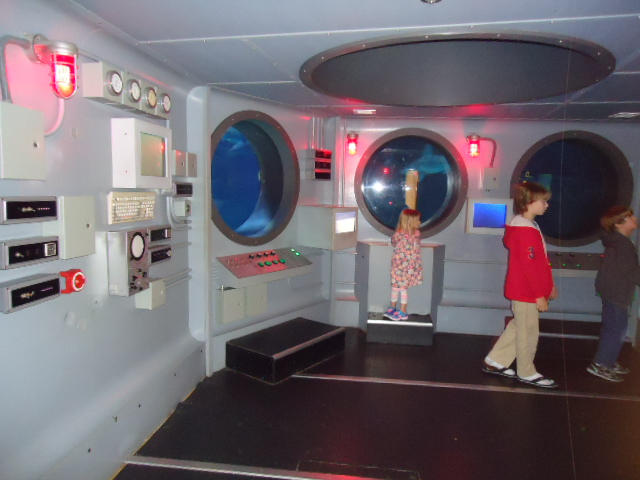
In the submarine control room, the boys spent a lot of time exploring the different controls and taking the vessel up and down, through the waters of the different ports.  One son recruited the other to join the Navy for World War II, and then we got side-tracked by the Naval Aviation section before chatting with a marine biologist.
.....but their hands-down favorite of the inside part of the museum was getting to drive the submersible vessel.  They used the robot arms to pick up objects on the sea floor, and learned that it is a really difficult thing to do!  After a little 'discussing' whose turn it was to pick things up again, we decided it was time to head outside for some fresh air.
Beside the museum stands the USS Wisconsin, a Naval submarine from the WWII era, now used as an educational piece.  It was considerably larger inside than the outside even lets on.  We took a few hours to explore every nook and cranny possible on the sub.  The boys were most fascinated by the radio / communications room of the submarine.  All those switches and knobs...

The Virginia Beach Aquarium has lots of different animals to look at, and a huge focus on oceanography!
Our son used this trip as a chance to speak with scientists and researchers while completing his Oceanography Badge for Boy Scouts.  It wasn't that crowded, so we were all able to have some quiet moments exploring the things that interested us most.  Then again, silly family time is important, too...  HELP!  We've been eaten by a shark!
The two favorite stops?  Inside a submarine - which the kids could actually pilot.  And the moment when the cobra fanned himself at us in warning.  Argh!  Finally, we stopped in at the travelling exhibit, which was all about dinosaurs.  The dinosaurs moved and roared, which was a little disarming, even to the biggest of kids!

Tuesday, November 3

Pirates of the Outer Banks

As any #boymom will tell you, the swashbuckling phase can be a lot of fun!  Donning pirate costumes and sword fighting for the glory...or chocolate!  After our stopover on Roanoke Island, we took the opportunity to learn more about Blackbeard and why the area is called the Graveyard of the Atlantic...

More than 2,000 shipwrecks lie off North Carolina’s Outer Banks. A dangerous mix of storms, shoals, and strong currents earn the area the nickname “Graveyard of the Atlantic.”  Stroll along Manteo’s waterfront boardwalks, pass the Marshes Lighthouse, and spend some time at the Roanoke Island Maritime Museum. 

The museum, a free attraction, is a mistake to miss. Friendly staff and vintage boats at the museum educate visitors and locals alike about the craft and history of boat building on Roanoke Island.  Learn more about Blackbeard at Teach's Hole, with The Story of Blackbeard.
So why is it called Graveyard of the Atlantic?
The warm waters of the northbound Gulf Stream meet the cold waters of the Arctic Current off Cape Hatteras at Diamond Shoals, and the entire coast is an area of shifting inlets, bays, and capes, representing a shipping hazard for both coastal and transatlantic vessels.  Because of this, there is an unusually high number of shipwrecks where these currents meet. 
There are hundreds of ships buried in the sands offshore.  They include a fleet of Spanish treasure ships, returning to Europe after successful raids in the Caribbean in 1750 only to encounter a hurricane and end up strewn along the North Carolina coast.  Also, the ironclad Monitor, which sunk off Cape Hatteras while being towed south following her famous battle with the Merrimac. 
This area off North Carolina is not the only deadly coastline. The shores of Sable Island, off Nova Scotia, are so littered with shipwrecks that it has also earned the name "Graveyard of the Atlantic."

Pirates & Graveyard of the Atlantic
Read
Watch
Make / Do

Monday, November 2

Roadschool Trip to the Lost Colony of Roanoke

Most Americans know the story of the “Lost Colony.” The village of Roanoke was the one of the first English colonies to be established on the soil, however this village ended up shrouded in mystery...

We began our study of the Lost Colony at the North Carolina History Museum in Raleigh.  Here, you'll find three floors of artifacts and exhibits spanning from pre-colonization to modern day.  

The Governor of this colony was John White. The small population of Roanoke complained about their lack of food and tools, and they believed that the Native Americans would launch a surprise attack on them. These complaints led to John White going to England, for nearly three years, to later return along with the proper supplies the colonists requested. 

When John White returned, he found a ghost town. The area which was once a village was stripped of its people. Houses and other shelters were nowhere in site. What was left behind were some small cannons, an opened chest, a tall fence built around the perimeter of the former village site, and a single word inscription carved on a fence post, “Croatoan.

Roanoke Island Festival Park

Further down the road, at the Roanoke Island Festival Park in Manteo, we got an intensive history lesson on the area, from the Native Americans to modern times.  We kicked off the day with a little duck-hunting at the boat museum...then stepped 400 years back in time.  At the settlement site, we saw settlers from the Roanoke Voyage of 1585. They show what daily life was like for the soldiers and sailors who traversed the Atlantic Ocean to build a permanent colony for England.
At the settlement site, we saw settlers from the Roanoke Voyage of 1585. They show what daily life was like for the soldiers and sailors who traversed the Atlantic Ocean to build a permanent colony for England.

With guns in hand, we first had to prove that we were friendly, and not here to attack!  Then we were allowed to enter, learn all about blacksmithing, and try our hands at woodworking and pottery making.  The boys spent some time practicing their knot-tying skills before we jumped forward in time.
On the Queen Elizabeth II, we got to help 16th century sailors set the sails, plot a course with an astrolabe, and swab the decks.  A good friend of Sir Francis Drake told us about his life and mission, and we helped some slaves below-decks to lift anchor.
Springing forward just a bit, we came to Indian Town, where the various aspects of native american life pop up along the trail.  You can roast meats, build a wigwam, and do a rain dance.  We learned about the different types of furs, and the advantages of using each, as well as how to plant the Three Sisters successfully!
Before the visit was over, the boys ended up as a promotional feature for Festival Park!!!!!