Click the graphic above to access all our novel studies!!

Monday, November 16

Roadschool Trip to the North Carolina Piedmont

The piedmont, or foothills, region of North Carolina falls between the mountains and the central plains.  It's where I grew up, so I enjoy taking the kids to visit the old haunts when we're home...  Here are a few of our favorites, including Spencer Trains, Old Salem, and Duke Chapel (arguably not actually in the foothills)....just don't forget the Cheerwine & barbecue!! 

The North Carolina Transportation Museum (known to us only as 'Spencer') hosts the remaining structures of the historic Spencer Shops, once Southern Railroad's largest steam locomotive repair facility on the east coast.  Buildings include the Back Shop, the Master Mechanic's Office, the Flue Shop and the 37-stall Bob Julian Roundhouse.  The museum is a source of education and fun for the young and old.

We checked in at the train station, purchasing tickets for a train ride, and then perusing the gift shop.  One of the most fascinating finds was this old trainspotter's guide.  We studied up in preparation for the big tour!

We used our ASTC passport to get free tickets for the train ride!  (I cannot tell you how much we save each year with this membership.  If you travel, you should have one.)  This railroad car was remodeled in the late 1940s, and boasted all of the luxury from the golden age of railroad travel!

I love this picture.  Isn't it funny when you get a momentary glimpse of the future?  Like us, our son has inherited the wanderlust.  I can easily see him boarding the Eurorail someday and touring the countryside by himself.  When I asked what he was thinking, he said he was trying to figure out how they had connected one of the tracks out there...
The Roundhouse Tour is a special treat at the end of your train ride. Lots of history in the photos, printed stories, and activities that they guide you through! There are also hands-on exhibits.  At the 'model' center, you can see a layout of the original train station. 
We started the afternoon with Bojangles, that southern fast food staple, and ended it with Monk's (that's Lexington BBQ...only the best barbecue on earth). We're having a gastronomic adventure through the foothills of North Carolina, and it's fantastic!

An hour or so up the road is the village of Old Salem.  Old Salem has wonderful actors who dress up in 18th century costume and demonstrate daily living and worship in the original community.  When visiting, you get to experience life over two hundred years ago through hands-on activities.  We are all about hands-on learning!
In the kitchen, and out in the garden, we learned about :
  • peeling, slicing, chopping vegetables and fruits / mincing herbs
  • cook pots boiling over an open hearth
  • preserving food (sauerkraut, dried apples)
  • making baskets & candles
  • sewing cloth
  • planting seed, harvesting & seed saving
  • composting, mulching, & preparing seed beds
  • using cold frames, hot beds, bell jars
  • pruning fruit trees
In the barn, and out on the field, we learned about :
  • gunsmithing
  • tool repair & sharpening
  • gathering fire wood
  • building fire & baking bread in the bake oven
  • making soap over an open fire
We happened to be visiting during Homeschool Days: 250 Years of History.  The kids got to learn how the Moravians built the town in the back country of North Carolina, starting in 1766.  Some of the activities included :
  • How oats/wheat are threshed
  • Harvesting herbs for home use
  • Write with a quill pen
  • Try 18th century chocolate
  • Learn how dyes were made out of natural ingredients
The boys got to try their hand at making shoes and an ax in the Single Brothers House.  They learned how to tell time and how to use single, double, and triple pulleys.  They learned how to measure ingredients with a scale, for baking.They also learned how to make candles, how to make ink, and how to make lye soap!

Occasionally, we get great ideas from the places that we visit.  It's wonderful to see and touch things that we've studied...and this underground root cellar / cold storage room was no exception.  We were inspired, and hope to do more research on this!

Located in the heart of North Carolina, Duke Chapel in Durham is an example of neo-Gothic architecture, which has stone piers, pointed arches, and vaults to create large, open spaces.  Combined, these elements create immense areas that are a bit imposing upon first seeing them.  We've studied various types of architecture on other field trips, but this was our first stab at Gothic.  

With its spires and enormous, arched doorways and windows, the chapel - as well as the rest of West Campus' architecture - is a neo-Gothic architectural beauty.  All of the stone for construction came from a quarry in nearby Hillsborough.
Both inside and outside, the use of consecutive arches frames the hallways, looking somewhat like tesselations.  Even the use of light (such as in these stained-glass windows) and shadow add to the beauty and mystery of Duke Chapel!

Monday, November 9

Roadschool Trip to Hampton Roads

With family stationed at a couple of Norfolk area bases, we have had the opportunity to explore the Hampton Roads area at great length!  Some of our favorite museums include the Nauticus and USS Wisconsin, Mariner's Museum, Living Museum, Military Aviation Museum, and Virginia Beach Aquarium.  There are so many fantastic places to visit in this area!!

At the Military Aviation Museum, near Pungo,  we visited collections of World War I and World War 2 airplanes.  They have some fairly unique exhibits in their collections, largely coming from Germany.  The WW2 hangar is an original from the airfield (and so hot!), and the Enigma machine was fascinating.  

There is a ladder that is used to service the Zepplin aircraft, and a nice demonstration of how the first aircraft machine guns operated.  One of the most interesting finds, though, was this set of classroom maps from Germany showing the battles and invasions...

The Virginia Living Museum in Newport News hosts exhibits depicting Virginia’s natural heritage from the mountains to the sea. Visitors experience animals native to Virginia in habitats, discovery centers, and interactive exhibits. There are hands-on exhibits, and the docents are fabulous with the kids!  The trail is nicely laid out, and easy to navigate, even on rainy days.  Before you go, make sure to pick up a museum study guide (choose your grade) to turn this trip into an even-more-educational field trip! 
Inside the museum, you'll find two large sun rooms with different Virginia ecosystems.  Learn about both the coastal and mountain regions, as well as the animal life they support.

Simulated caverns showcase nocturnal animals.  We even found our oldest son's relative.....the pack rat.  During the downtime, we got to learn what it would be like to be a turtle!  It's actually quite difficult to navigate!
Outside, on the trail, we learned how to distinguish the tracks of all the animals we were about to see.  While many of these animals were not new to the children, there was still a lot of information on the placards that they didn't know.  It's a bit like a zoo, but with animals strictly from the local area - such as the red wolf and bald eagle.

Their favorite parts about this museum?  The big one loved getting to see the bald eagle up close and personal (yes - we were only about three feet away...that's not a zoom lens).  The little one enjoyed the virtual dissections, like the frog one shown above.  He got to take apart the animals, and learn the anatomy, without having to get messy!

The Mariner's Museum covers seafaring history of the Virigina coast, from the early explorers to modern day.  As a homeschooler, I appreciate the various study guides they offer online.  You can study everything from the Voyage Across the Sea (66 pg of lessons!), to the Birth of the Navy, or even the Battle of the Atlantic.  There are more than a dozen guides available!

One of the boys' favorite exhibits was the USS Hunley, a Civil War era submarine that has been re-created.  They discovered that it was a lot smaller inside than anticipated!  Nearby, they were able to design their own submarine and then discover it's merits and pitfalls in battle.  This was a great engineering exhibit, and we spent a lot of time here.

They were able to role play in the Captain's Quarters, seeing how well he would live in relation to the various enlisted men.  At another section in the museum, we were able to see the real submarine, as it is being restored in an underwater environment.

Near the Naval Shipyards of Norfolk is the Nauticus Museum and USS Wisconsin.  This one is the hands-down family favorite museum to visit in the area!  I think they like the combination of history, science, and battle aspects all rolled into one....plus the ship.  They love the ship!

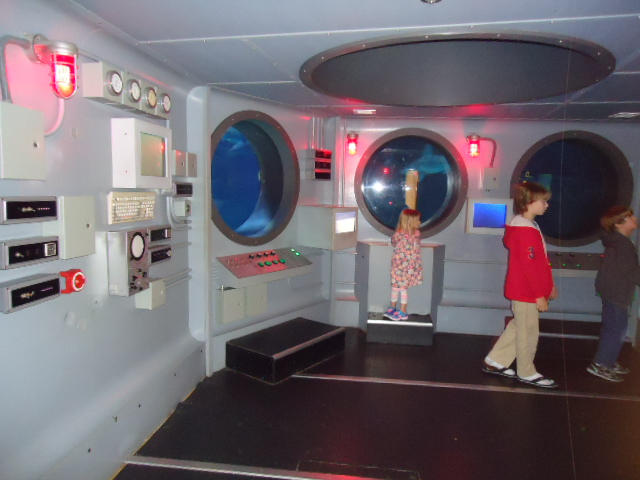
In the submarine control room, the boys spent a lot of time exploring the different controls and taking the vessel up and down, through the waters of the different ports.  One son recruited the other to join the Navy for World War II, and then we got side-tracked by the Naval Aviation section before chatting with a marine biologist.
.....but their hands-down favorite of the inside part of the museum was getting to drive the submersible vessel.  They used the robot arms to pick up objects on the sea floor, and learned that it is a really difficult thing to do!  After a little 'discussing' whose turn it was to pick things up again, we decided it was time to head outside for some fresh air.
Beside the museum stands the USS Wisconsin, a Naval submarine from the WWII era, now used as an educational piece.  It was considerably larger inside than the outside even lets on.  We took a few hours to explore every nook and cranny possible on the sub.  The boys were most fascinated by the radio / communications room of the submarine.  All those switches and knobs...

The Virginia Beach Aquarium has lots of different animals to look at, and a huge focus on oceanography!
Our son used this trip as a chance to speak with scientists and researchers while completing his Oceanography Badge for Boy Scouts.  It wasn't that crowded, so we were all able to have some quiet moments exploring the things that interested us most.  Then again, silly family time is important, too...  HELP!  We've been eaten by a shark!
The two favorite stops?  Inside a submarine - which the kids could actually pilot.  And the moment when the cobra fanned himself at us in warning.  Argh!  Finally, we stopped in at the travelling exhibit, which was all about dinosaurs.  The dinosaurs moved and roared, which was a little disarming, even to the biggest of kids!