Click the graphic above to access all our novel studies!!

Wednesday, April 22

Do-it-Yourself Scale & Chain Maille

We like to get hands-on with our studies here.  The idea for making chain maille came from multiple sources....

So we picked up some more jump rings and the boys started making chain maille!  Words of wisdom...this is not an overnight project.  If you want to make full, usable pieces, it will be a labor of love.  I now understand why this stuff costs so much to purchase...
(Tutorial by our son)  Before beginning to weave the maille together, I began by creating a base to place it on. In this case, I am making a pair of bracers, so I measured my arm and created a pattern. This time I made the base from old blue jean denim. When making something such as a hauberk or coif, you would not make a base for it, but you would still want to form a pattern. 
I found that taping the ends helps to secure the maille in place while weaving it.

Love these projects?  Check out his armor-work and other costume designs at Sparks Forge & Armory!


Be cautious when attaching scales and rings.  Even a small mistake can cause big problems as you continue to add more and more rings built upon the last.   After a great deal of time and effort you will end up with something like this.  
As a side side project I also made this medieval style manuscript with my new calligraphy set. Few will recognize the language and even fewer will know it by its true name, tengwar. After making only one page with some markers its easy to see why books were valued more than gold.


This video explains step by step how to make sheets of chain maille using the European 4-in-1 pattern. The title of the video is incorrect as it only shows how to make chain maille not scale maille. A scale maille video is below.
Here is the video for how to make scale maille.

Love these projects?  Check out his armor-work and other costume designs at Sparks Forge & Armory!


Tuesday, April 21

Roadschool Trip to Nashville

On our roadschooling adventure to Nashville, we stopped at the Ryman Theater and the Parthenon...

We rolled into Nashville in the afternoon, stopping to visit the Parthenon and Centennial Park before heading down to Music Row to soak up the culture.  What we hadn't counted on was not being able to take the kids into most of the places after a certain time...luckily, a few are "open bars," which allowed us to stand outside and listen to the music.

Traffic in this area of town is insane!  Find a parking lot, pay your fee, and walk as much as possible.  Most of the museums, like the Ryman Auditorium and Country Music Hall of Fame, are within walking distance.  The modern-day Grand Ol' Opry House is a few miles away, however, and you'll have to drive over there.
The small museums are just as much fun as the larger ones!  We visited the Johnny Cash Museum, the Sun Records Museum, and the Dukes of Hazzard Museum.  Many of these discourage photography inside.  The highlight of our stop, however, was the Ryman Auditorium.  The youngest is as much into music as his momma, and we had special arrangements to record our very own duet!!!  Life can be very cruel, however, and this is how that day began :
Oh well.  No worries...we'd just have fun!  After hanging around waiting for it to open, and appreciating the architectural grandeur of the building, we headed in for a behind-the-scenes tour of the former home to the Grand Ol' Opry!  After dancing around a bit, and getting the wiggles out, the kids met with Minnie Pearl and Roy Acuff.  We got a little history of the Ryman and watched Minnie work her comic magic!
The auditorium itself hasn't changed much over the years.  Granted, it fell into ruin and was completely renovated, but standing there now is like being there sixty years ago.  It's easy to fall back in time and fall in love with classic country all over again.  The equipment, however, is state-of-the-art, and they produce several shows there each year.
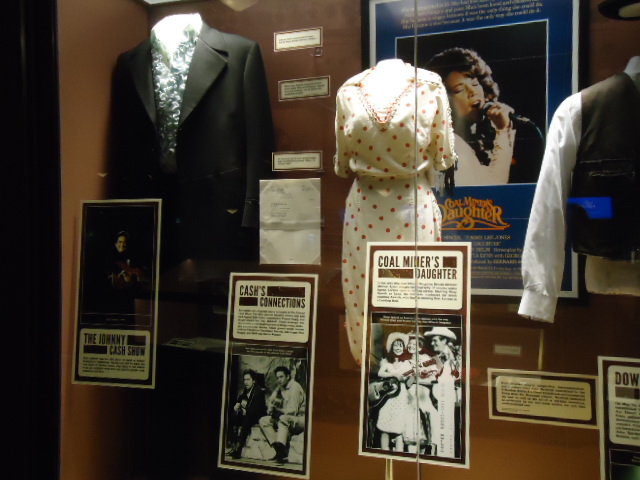
Around the sides of the auditorium are several cases filled with country music memorabilia, such as Patsy Cline's gold record and classic outfit; the dress worn by Sissy Spacek in Coal Miner's Daughter; one of Johnny Cash's black suits; and much much more!
Finally, it was time to step into the recording studio with my little bug-a-boo and record our duet.  There are only a handful of songs to choose from for the recording, and that was very difficult since he only knew one of them.  On the other hand, we didn't obsess over which song to record!!  Hank Williams Sr. is not an artist that my voice lends itself to on a regular day, and the combination of his speech impediments with my throaty hoarseness was...interesting.  We had a blast!!  And we recorded a song that will remain safely tucked away in our own home.  But you know, #YOLO.  You only live once!  Make it count! 

Grand Ol' Opry Resources:
On the other side of town, just a few miles away, lies a building that my oldest was very excited to tour!  Being an ancient history nerd nut, he's all about the Parthenon.  You can pay to go in and see the replica Athena statue, but you can also get a great history lesson without going inside.
We had recently finished our study of Ancient Greece, so we took some time to study the friezes on the pediment of the temple.  Inside the building are the actual molds used to re-create the frieze.  You can follow the process of copying the original Parthenon in Greece, and 'meet' the team that made it happen!
Contrary to popular impression, Greek statues and temples were not pure white. They were painted in what we would regard today as bright, garish colors.  Case in point, check out Athena and her accoutrements.
From the Parthenon, head over to the obelisk that's going to be to your left on the backside of the Parthenon.  This park was created to celebrate Nashville's Centennial, and they've got an amazing historical monument celebrating the achievements of Nashville.  Take some time to see what they considered to be important about their town.  While you're at it, stroll around Centennial Park.  It's a great leg-stretch stop!


For more on Greek Mythology, check out the novel studies on Percy Jackson!

Greek Goddesses Resources


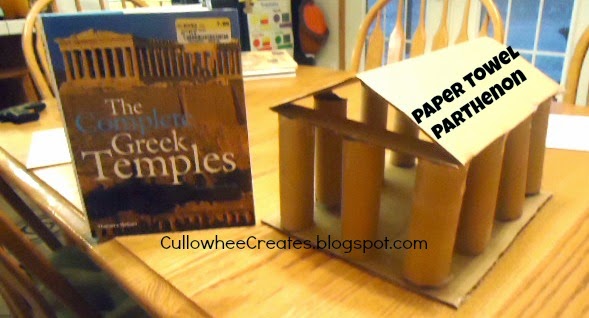
Paper Towel Roll Parthenon

Supplies:
  • Toilet paper rolls (or paper towel rolls, cut into half)
  • Cardboard rectangle (2)
  • Glue
  • White paint (optional)
  • The Complete Greek Temples
Directions:
  • Cut all of the tubes so that they are the same length.
  • Cut a square / rectangle from cardboard to use the base.
  • Glue the tubes along the base, all the way around, at equal distances apart.
  • Fold the other cardboard rectangle into a triangle, and make a roof.  Glue it to the top of the tubes.
  • Spray paint it all white, if you want to.

Wednesday, April 15

Choosing the Right Curriculum for Your Family

Choosing the right curriculum for your family means first determining your family’s homeschooling style. Some families are strictly one style, while others prefer a blend of styles... 

Your family might try out one style and find that it’s not for you. It may take a few years to settle down into the right fit for your family, and that’s completely normal.

What style is best for your family?
When choosing a style (and there’s a good chance you’ll change as your children grow), consider these questions…

  • What’s your teaching style?
  • What are your goals?
  • How do your kids learn best?
  • What values do you want to instill in your children?
  • What’s your lifestyle? Do you prefer routine or flexibility?
Classical
This approach utilizes three stages of learning : grammar, dialectic, and rhetoric. These stages match up with elementary, middle, and secondary school. This is a rigorous approach to schooling, but produces results. 

Charlotte Mason
Developed by a 19th century educator who believed in reading 'living books' rather than 'twaddle,' this approach involves living learning. It revolves around reading aloud together as a family, and following child interests. Nature walks, art museums, and living books are all a part of this approach. 

Unit Studies
This approach takes all of the subjects and smashes them together in an in-depth study of a topic. For example, a unit study of Rome might include reading and writing about Rome, studying the history of Roman emperors, calculating timelines and marketplace purchases, creating artwork and projects from Ancient Roman times, and studying water (from the aqueducts built during this era).  Units may be literature-based, and this is a great style for teaching multiple grades together.

Unschooling
Definitely for the Type B family, this is a child-centered approach to schooling. There are no formal lessons, or even formal curriculum, but the children follow their interests and learn from life experiences. Schedules are not utilized, and there is much flexibility and freedom. This does not mean that they don’t read, write, and do math, but that they follow their interests. Math might be adding up the tab at the restaurant, or figuring the tax.
  • Includes
    • Child-led learning
    • Lifeschooling
    • Roadschooling
    • Waking up and finding the beauty in each day

Waldorf
Similar to unschooling, this is a child-centered approach that focuses on nature, arts, crafts, music, and movement. Technology is not a big part of this curriculum.

Eclectic
This is just a fancy way of saying ‘a combination of styles.’ 
  • Includes
    • SchoolhouseTeachers
    • Just a little bit of everything!
    • Pick & choose from the smorgasboard of styles

Textbooks
This is a fairly common style in the first few years of homeschooling, especially if you've pulled your children out of public school, to build confidence.  Don't forget to do a bit of de-schooling before starting the semester! 

Stay-at-Home School
A lot of organizations don't consider this to be "real" homeschooling since it's being paid for and run by the government and someone else is doing all of the teaching.  For a small percentage of people, though, whether it be because of job commitments, life 'events,' or something else that is preventing them from being able to sit down and dedicate themselves fully to educating their children, this really is the best fit.  It's never my first recommendation, but still a valid option.
One of our favorite all-in-one resources for families is SchoolhouseTeachers.  It includes all classes, for all grades...and it's one price for the entire family.  There are many different learning styles to select from, so if you have one visual kid who needs a relaxed pace and one aural kid who needs a more stringent pace, there are classes that will fit them each.  With over 475 classes available, plus extras for mom and dad, this is my favorite resource to offer new families who are wanting to dip their toe into homeschooling but don't even have an idea of how to answer the above questions!

U.S. Homeschoolers!Try out SchoolhouseTeachers for only $5!  Spend the entire month poking around, trying out courses, and seeing iff it's a good fit for your family.  {Hint - we think it will be!}  For the cost of a cup of coffee...what have got to lose?!


When choosing a curriculum for your family, you'll want to consider 'intelligence' and learning styles.  A Genius in Every Seat helps you work through determining these factors...
As a teacher, how do you assess intelligence?  Do  you provide and develop opportunities for students’ intelligences, or instead teach to your own?  These can be hard, thought-provoking questions.  Yet, answering each of these is essential if you are to truly examine your educational practices.  How can you best serve the needs of your students?  This examination begins with an assessment of your students’ intelligences.  This e-book comes with a workbook component for surveying yourself and your students, along with suggestions for putting the results into practice.

Snag a slew of resources in the Homeschool Helpers Bundle!


Covers ten topics to get your homeschool running smoothly!
 
Getting Started
· A Parent’s Alphabet
· Choosing the Right Curriculum for Your Family
· Motivating Your Teens
· Seven Steps to Teaching Work Ethic
 
Special Needs
· Occupational Therapy in Homeschool
· Speech Therapy in Homeschool
· Teaching the Distracted Child
 
Making it Fun
· Game-Schooling – Learning through Play
· How to Snag Free E-Books
· Holiday Foreign Language Fun

Looking for more?  Check out the original Mom’s Bundle and Homemaking & Homesteading Bundle!

Tuesday, April 14

Taxes for Teens (Life Skills)

Look for more in-depth discussion of this topic and more in Through the Door: Homeschool to College Success! This book & worktext set will help you and your high school student breeze through the steps of college and scholarship applications, as well as brushing up on study habits and life skills. The worktext includes activities, worksheets, and planning pages, and accompanies the book.

What's the Deal with Taxes?
You can see sales tax when you go to purchase something, and the price of something you buy at a store upon checkout is higher than the shelf price.  Similar to sales tax, the government charges income tax.  The income you earn goes to pay for your home, food, expenses, and clothes.  The government takes a portion of the money you earn to help pay for others' home, food, clothes, and expenses...as well as public education, public healthcare, emergency funding, and the military.

In the US, taxes must be filed and paid by April 15th.  The IRS (Internal Revenue Service) enforces tax law, and you don't want to mess with them, so your best option is to accurately figure out what you owe and pay it.

Interestingly enough, taxes didn't exist in America until 1913, when Woodrow Wilson passed the 16th amendment saying, "The Congress shall have power to lay and collect taxes on incomes, from whatever source derived, without apportionment among the several States, and without regard to any census or enumeration."


What Should I Know?
Any job is going to be subject to both state and federal taxes.  Each state has its own set of rules, so you'll want to check with a tax expert to see what applies in your state.  To muddy the waters further, tax laws change annually, so what was right this year may not be right next year.

If a teen is under the age of 19, and earns less than the standard deduction amount, an income tax return probably won't need to be filed.  This can vary though, depending on whether there is passive income (such as investments).

When your teen is first hired, pay attention to how they are classifiedRegular W-2 employees will have the tax withheld, which could result in a refund later.  Contract employees don't have any taxes withheld, which means you have to figure out what you owe and pay self-employment taxes to the government later.

Investments seem like such a good idea...and they are!  But when it comes tax time, they can become a headache.  If investment income surpasses a threshold (it changes annually, so look up the current one), it is generally taxed at 10%.  One idea could be to put investments into a Roth IRA, so that it will grow tax-free.  Be sure to check all of the Roth IRA rules before moving your money.
   
Get Some Practice...
Upon being hired for a job, there is usually a slew of paperwork to complete.  As an adult, we can feel overwhelmed by this...can you remember how it feels to complete it as a teen?  These forms can be intimidating!

Monday, April 13

Middle Ages Unit Resources

Year one of The Good & the Beautiful History focuses on the Middle Ages.  With knights and castles, Joan of Arc and King Alfred the Great, and the ever-popular-with-boys Black Death, this is a unit that begs for extra 'fun learning' time!

As we wrapped up this unit on the Middle Ages, we wanted to do something special with the kids.  Going to Medieval Times was our first choice, but the closest one is several hours away and the timing was just not right.  We found this cute little English pub in Tulsa, called The White Lion, and decided to take the kids there for some authentic British food and a little bit of culture...

What a fabulous meal we had!  If you're ever in the Tulsa area, this one is a must visit.  It's low-key and seems to be one of those places known only to the locals and by word of mouth.  We had hot tea, brie & apples, bangers & mash, cottage pie, and fish & chips.  After dinner, the boys chatted up Queen Elizabeth...

Make Medieval Stained Glass Windows

Designed by a kid, and for kids, the projects in Recycled History, like this one, will keep them enthusiastic about learning! All projects are created with items found around the house....many that would be headed for the trash bin....and the book includes directions and photo-directions.  

Projects are history-based, and span from ancient civilizations to modern times. They are designed to get kids excited about learning, and include sculpture, costumes, flat art, woodworking, and more!

Product Review
"Although it's written by a young man, it's got some fantastic ideas!! This is the first product I have found (I've been looking for a long time) that gives ideas and suggestions for making costumes for boys to reenact history activities, like pretending they are living during a specific period and letting them dress the part.  The craft ideas are also wonderful for helping a hands-on learner better understand the periods that are covered by this product. I am so happy I found this and it's helped us quite a lot. Now, to find a pair of football pants before we finish Colonial America! lol"    ~Edwina, March 2017


Supplies

Directions
  • Print out the picture that you want to copy. We used shields and crests.
  • Trace the picture on the tracing paper with the black marker.
  • Color it with crayons. Use bright colors. Don't color too hard, or the wax will run!
  • Cut out your shield and laminate it to make the colors even brighter. 
  • Hang it up and let the sun shine through!
Grab a copy of Recycled History!


Read

Watch
Make / Do

Pick up a printable copy of this unit in the Humanities Unit Study Bundle!

Includes seventeen unit studies covering history and language arts based topics. Each unit addresses a new topic, spanning ancient through modern history and various writing styles.
  • Each unit has introductory text, which will give the student basic background information about the topic at hand.
  • There are photographs and illustrations, and we have also included primary documents when available.
  • After this text, there are featured videos, which augment the background information and help make the topic more accessible for more visual students.
  • You will also find a short list of reading books.
  • There are vocabulary words, places, and people to identify.
  • Reading comprehension, critical thinking questions, and writing assignments are included.
  • We add fun with hands-on activities and extra videos to watch that will bring the era to life.
  • Some units also have cooking projects.
These studies are directed toward upper grades students, but some have resources for younger students so that the whole family can work together. Our family has used unit studies as curriculum for many years, and we hope that your family will enjoy these, too!