Click the graphic above to access all our novel studies!!

Thursday, September 12

Occupational Therapy in Homeschool


You might also be interested in Speech Therapy for Homeschool.

Occupational therapists focus on tasks involving fine motor skills, such as shoe-tying or handwriting.  Physical therapists offer exercises to improve strength, balance, and coordination, which helps with walking up stairs, running, and jumping.  Both are very much needed by children with developmental delays, but therapy is time-consuming and can get expensive very quickly.  

As homeschool parents, we are responsible not only for our children's education, but to make sure they receive any needed therapies.  Here are a few ideas to help you with basic therapy at home...

What are the signs of a delay?  If you are reading this, you probably already know whether your child is delayed, but here is the general checklist.

In younger children some of the signs of a motor delay include:
  • Not being able to bring their hands together by 4 months;
  • Not rolling over by 6 months;
  • Having head lag when pulled to a sitting position after 6 months;
  • Not sitting by themselves without support by 8 months;
  • Not crawling by 12 months;
  • Not walking by 15 months;
It can be difficult to judge with an older child, but generally :
  • often described as clumsy or forgetful
  • may have difficulty using a cup, spoon or fork to eat.
  • may have the tendency to drop items or run into walls/furniture
  • may have trouble with tasks requiring hand-eye coordination and dexterity
  • may also have difficulty holding a pencil and learning to write

Watching your children struggle with daily tasks is difficult.  We want them to succeed, but they have to learn on their own.  I cannot, and will not, tie my son's shoes until he is married...only to pass that task onto a wife.  So, we came up with new options.


  • Lock Laces.  These have saved us such heartache, and they are the very first thing I would recommend for a mom with older children!!  After years of trying to tie shoes, my son is now able to wear sneakers like all of the other children, thanks to Lock Laces.  And no more "baby velcro shoes."
  • Pencil Grips.  Again, a must-have for your homeschool.  Handwriting is a burden for these children.  No matter how hard my son tries, he cannot write legibly.  With the Pencil Grip, his fingers stay in the correct place, and we can at least make out 70% of what he's written...which is enough to decipher the rest.  Do we have a ways to go?  Absolutely.  But he's got enough confidence now to keep on keepin' on.
  • The Quiet Book.  This is a church-specific book for us, because it keeps him occupied during long sermons.  Any other time, he would balk that "it's a baby book!"  But he needs to learn the skills.  The Quiet Book focuses on zippers, buttons, snaps, and even shoe-tying.
  • Simon Swipe.  Remember the classic game, Simon?  Of course you do!  It's back, but with a twist.  Simon Swipe has been a fantastic addition to our son's therapy.  It's a big kid toy, and he even has to fight his brother to get to play with it (as you know, making it even more desirable)!  This combines auditory perception with fine motor skills and motor planning.  And did I mention that it's NOT a baby toy?  It's a great tool for older children.
  • Activities for Gross Motor Skill Development.  This book is for you, mom.  It will help guide you through games that will build your child's skill and confidence.
  • Activities for Fine Motor Skill Development.  This is your cutting, pasting, handwriting...and some tools and games to improve those skills.  
  • Handwriting Practice.  You might also print out some of these free handwriting skills sample sheets.  There are many different historical eras to select from...pick the one that interests your child.  You can choose the grade level based on your child's reading level, but then select manuscript or cursive, as desired, for extra practice.

If you're lucky, you are only coping with motor skills delays.  If you're like many of us, you have a Rolodex of therapists.  (Does anyone use those anymore?  Other than me?)  We have also compiled several resources for speech therapy in your homeschool.

Math Class & Occupational Therapy Combined
Our son needs kinesthetic, or tactile, learning methods. It can be very difficult to find materials for this learning style, but typically the ones labeled 'Montessori' will fit the bill.  

After a few years of math lessons, and still no progress on being able to count by ones, we tried having him write out his numbers regularly.  But it wasn't until we discovered this Montessori hundred number board that things began to fall into place!
The set comes with one hundred wooden numbers, from 1-100, a grid board, and also a storage box for the number pieces. All of the wooden pieces are smooth, so you don't have to worry about splinters.  It comes with a printed-number page, but also with a blank page for more advanced learners.  It's sturdy, it's hands-on, and in a matter of weeks, we are noticing the difference!


How does it relate to occupational therapy?  Simple.  You're working with small pieces, so tuning those fine motor skills.  Also, by physically touching the squares, it helps the brain to integrate that learning.

Occupational Therapy At Home

  • Massage – Deep pressure helps our son when he begins to feel a loss of control.  It also helps to get him moving when he has no energy.
  • Trampoline –  There's something about bouncing that helps to center sensory children.  Even a small living room trampoline will do the trick!
  • Baking cookies -  For a sensory experience, try hand mixing cookie dough.  It might be a challenge at first, but the promise of fresh basked cookies usually helps us get started.  Need deeper muscle challenges?  Pull out the mixer and lug it up to the counter.
  • Gardening – Another sensory activity for a sunny day, getting hands dirty and smelling soil and fertilizers can help to desensitize against smell and texture issues.
  • Kinetic sand – An inside / dreary day activity, this is a good starting point for sensory / texture issues.  The sand doesn't get into everything (like regular sand), but still allows for that 'sandy' sensation.  It can be molded and played with...make a sand castle!
Subscription Box Option
Sensory TheraPLAY Box Photo 1Sensory TheraPLAY Box
Sensory TheraPLAY Box offers monthly deliveries of fun and therapeutic sensory items. Makes a unique and memorable gift for children ages 5-9!
  • Items encourage the development of important sensory motor skills and are both calming and therapeutic
  • 5-7 sensory toys and items are inside each month's box
  • Boxes ship out the first week of each month
  • Items include: putty, aromatherapy dough, hand fidgets, tactile/ textured toys, etc.
  • Beautifully and thoughtfully created – makes the perfect gift!

Meet OT Mom!
As a homeschooling mom with a background in pediatric occupational therapy, OT Mom provides activities and resources for at-home occupational therapy that doesn't require fancy equipment.

Our tween son still requires assistance with fine motor skills, and finding activities that aren't overtly babyish can be a problem.  Using the cutting skills pack, we were able to create a scary snake, some Christmas decorations, and make a 'rocket tree.' 
You'll notice in the first picture of the 'rocket tree' parts that the pieces aren't cut very well.  We make a game out of it and just keep trying...and in the second picture, they are done much better!

Some of our favorite resources - that we have personally used - include:


Snag a slew of resources in the Homeschool Helpers Bundle!


Covers ten topics to get your homeschool running smoothly!
 
Getting Started
· A Parent’s Alphabet
· Choosing the Right Curriculum for Your Family
· Motivating Your Teens
· Seven Steps to Teaching Work Ethic
 
Special Needs
· Occupational Therapy in Homeschool
· Speech Therapy in Homeschool
· Teaching the Distracted Child
 
Making it Fun
· Game-Schooling – Learning through Play
· How to Snag Free E-Books
· Holiday Foreign Language Fun

Looking for more?  Check out the original Mom’s Bundle and Homemaking & Homesteading Bundle!

Monday, September 9

Roadschool Trip to Chocolate World + Who Was Milton Hershey?

What's the sweetest town in the US of A?  Did you guess Hershey?  It's where the streetlights are chocolate kisses, and one of the yummiest places to visit!

Before our first visit to Hershey, we read the book Who Was Milton Hershey? and learned about how the Hershey empire began.  It's a short read-aloud, and gave the boys a good perspective for the tour.  (Instead of just being hypnotized by chocolate.) 
We kicked off the day with the free factory tour.  After all, they give you free chocolate at the end of the ride!  There's a little camera that takes your picture during the ride, and we got a little silly...  Those little dots are Hershey Kisses.  (Originally they were called 'smacks' because of the sound that is made when they come out of the machine, but someone thought 'kisses' sounded better.)  During the short time we were on the tour, the factory produced over 5,000 kisses!


How Hershey Chocolate is Made...
It takes 270 pounds of cacao beans to make one pound of chocolate.  Cacao pods are harvested  by hand.  Inside each pod are 20-40 cocoa beans.  The beans are separated and fermented to develop the rich flavor we love!  After harvesting, the beans are fermented.  They are gathered in large piles, where they sit for a week.  The shells harden, the beans darken, and a rich cocoa flavor develops.  Then they are bagged and shipped to the chocolate factory.  The almonds used at Hershey come from California.  There are eight almonds crushed into every single bar of Hersheys w/ Almonds.
A personalized candy bar is one of the coolest souvenirs we've picked up recently!!  At the Make Your Own Candy Bar studio, you get to customize your bar exactly like you want it...from start to finish.  First stop, choosing what kind of chocolate you want for the base.....I'm a dark chocolate kind of girl.  😃

After getting the mix-ins, each bar gets a second coating of chocolate and then is sent through the cooler.  The cooling tunnel takes six minutes to pass through, and the temperature and humidity adjust so that water droplets do not form on the chocolate.
While awaiting the finished product, you get to create your own chocolate bar wrapper at the design studio!

Hershey Chocolate Resources

Milton Hershey, the Philanthropist
In a town built by chocolate, where even the street lamps are shaped like Hershey's Kisses, everything is just a little bit sweeter.  But the sweetest story of all is the biography of Milton Hershey (see video below).  He poured his soul into creating a good product and then using the proceeds to enrich the lives of as many people as he could, and his legacy remains at the Milton Hershey School.  The few children selected to attend this school number themselves among the very lucky!!
On the Trolley Tour, you get a historic picture of the area.  We began with some of the first buildings in the town, including the church.  Our tour guides could not have been any funnier!!  Even my chronically-underwhelmed preteen was rolling in the aisles with laughter as we watched "Wilbur" transform into various members of the Hershey family and townspeople throughout the past century.  The schtick worked, though, and they remembered almost everything they learned.  If you have time, definitely take the tour!

Parting Shots...

Friday, September 6

Teaching About the September 11th Attacks


What happened on 9/11?
On September 11, 2001 .... Terrorists attacked the US.  They hijacked 4 airplanes in mid-flight, and flew two of the planes into two skyscrapers at the World Trade Center in New York City.  The impact caused the buildings to catch fire and collapse.  Another plane destroyed part of the Pentagon (the U.S military headquarters) in Arlington, Virginia.  The 4th plane crashed in Shanksville, Pennsylvania.
Officials believe that the terrorists intended to destroy either the White House or the U.S Capitol building.  Passengers on the plane fought the terrorists and prevented them from reaching their goal.  In all nearly 3,000 people were killed in the 9/11 attacks.
When people think of 9/11, they commonly think of NYC, but let's not forget the other two planes that carried victims that day.

Who attacked the United States?
A total of 19 terrorists hijacked the 4 planes on 9/11.  All of the men were from nations in the Middle East.  They belonged to a Terrorist group called Al Qaeda, and were led by Osama Bin Laden.  Al Qaeda practices an extreme version of the religion of Islam.  The group is intensely opposed to the US and other western, democratic nations.  They are especially against the military presence of these countries in Arab nations.  Since the group's creation by Bin Laden in the late 1980's, Al Qaeda has helped coordinate and fund numerous bombings worldwide.

How did America respond to September 11th?
In October 2001, the U.S and it allies invaded Afghanistan, where Al Qaeda was based.  The extreme Islamic group that ran Afghanistan's government, known as the Taliban, was protecting Bin Laden and allowing Al Qaeda to run training camps in the country.  U.S-led forces soon brought down the Taliban.  They are still working to help rebuild and stabilize the nation.  Since 2001, many Al Qaeda members have been captured or killed.  On May 1, 2011, U.S troops killed Bin Laden when he was hiding in Pakistan.
The U.S invaded Iraq in 2003.  Then-President Bush and other U.S leaders believed that the country's dictator, Saddam Hussein, was hiding terrible weapons that could be given to terrorists.  Hussein was captured and later put to death by an Iraqi Court.  No weapons of mass destruction were found.

How did America change after September 11th?

Following 9/11, the U.S government  took many steps to try to make the country safer.  It tightened security at airports and in public buildings.  For example, no longer could you drop off or meet loved ones at the airport gate.  A new cabinet-level department, the Department of Homeland Security, was created.  It works to protect the U.S from terrorism.

September 11th Unit Study Resources


**If you only choose one resource, we recommend the Memorial Museum, as it has excellent resources.**

Video should be screened by parents before showing


Pick up a printable copy of this unit in the Humanities Unit Study Bundle!

Includes seventeen unit studies covering history and language arts based topics. Each unit addresses a new topic, spanning ancient through modern history and various writing styles.
  • Each unit has introductory text, which will give the student basic background information about the topic at hand.
  • There are photographs and illustrations, and we have also included primary documents when available.
  • After this text, there are featured videos, which augment the background information and help make the topic more accessible for more visual students.
  • You will also find a short list of reading books.
  • There are vocabulary words, places, and people to identify.
  • Reading comprehension, critical thinking questions, and writing assignments are included.
  • We add fun with hands-on activities and extra videos to watch that will bring the era to life.
  • Some units also have cooking projects.
These studies are directed toward upper grades students, but some have resources for younger students so that the whole family can work together. Our family has used unit studies as curriculum for many years, and we hope that your family will enjoy these, too!

Thursday, September 5

Fire Cider & Kombucha for Pennies


It's getting into cold & flu season, when staying healthy will become a task (especially if you have littles)! Today, we're going to bring you two recipes - one for short-term health and one to promote long-term health.


Fire Cider
Fire Cider is a remedy for upper respiratory infections with a deep cough and severe nasal congestion. It is extremely spicy, and I don’t think there will be very many kids who will want to take this remedy. 

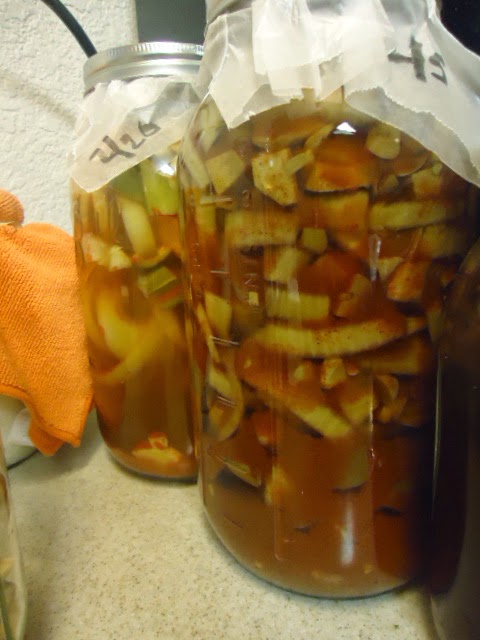
Take a tablespoon full every day - it's a very potent remedy, so go slowly with it. We mix it up by the half-gallon, but as you can see, currently have an entire gallon of this spicy-goodness brewing on the counter!

Ingredients:
  • 1 part minced garlic
  • 1 part chopped whole onion
  • 1 part grated horseradish root
  • 1 part chopped & seeded jalapeno
  • 1 part grated ginger root
  • ¼- ½ teaspoon Cayenne pepper
  • Raw apple cider vinegar
  1. Place all of the herbs in a glass jar and cover with apple cider vinegar. 
  2. Make sure to put plastic between the lid of the jar and the vinegar, or else it will create a slime due to a chemical reaction between the metal and the vinegar. 
  3. Steep herbs for 4-6 weeks, shaking daily, then strain and keep in a glass jar.
If you don't feel up to making your own, you can always buy a bottle.  

Kombucha
When I first read about the panacea of benefits of Kombucha, I was skeptical. How could one beverage do so many things? But then I realized that it’s not like a medicine targeted at curing specific symptoms - it’s more that it promotes health. It gives your body what it needs to heal itself by :
  • aiding your liver in removing harmful substances,
  • promoting balance in your digestive system, and
  • being rich in health-promoting vitamins, enzymes, and acids.
The general consensus seems to be that with regular, daily consumption, you’ll notice improvement in immune system functioning and energy levels within about a week, the healing of more minor ailments within a month or so, and the healing of more radical illnesses within a year or so.

Kombucha is the sour-dough bread of drinks....and just as easy to make! 

 All you need is sugar, a SCOBY, unflavored tea, and a glass fermentation jar.  We saved our GTs kombucha jars (this is a great brand to try, if you're just wanting to ease into the beverage) and use them for re-bottling.  


  • Boil up some sweet tea and let it cool a bit (so you don't kill your scoby with the high heat).
  • Pour it into your continuous brew system.
  • If you want a second ferment and / or to add flavor, add some juice.
    • I usually use Ginger Soother, homemade Elderberry Syrup, or Tart Cherry Juice for my mix-in, but you can use anything with good sugars in it.  The sugar is what feeds Scooby.  (We call our scoby "Scooby.")
  • With a continuous brew system, you'll be making new tea approximately every week, depending on how much your family drinks.  The old kombucha in the system will act as the starter and aid Scooby in creating good new kombucha.  
  • You will want to occasionally clean your system.  
    • To do so, empty almost all of the kombucha (we usually bottle it in those old jars), but leave about a cup or two of liquid with your scoby (put these in a bowl). 
    • Wash out your fermentation jar and spigot well, let it dry, and then place scoby and liquid back into it.  
    • Mix up a couple of batches of tea to fill it, and then allow it to sit for at least a few days (I wait a week) to get a good ferment going on again.


I usually recommend folks to buy a bottle or two so they can see which flavors they prefer for the second ferment....there are several options out there!